

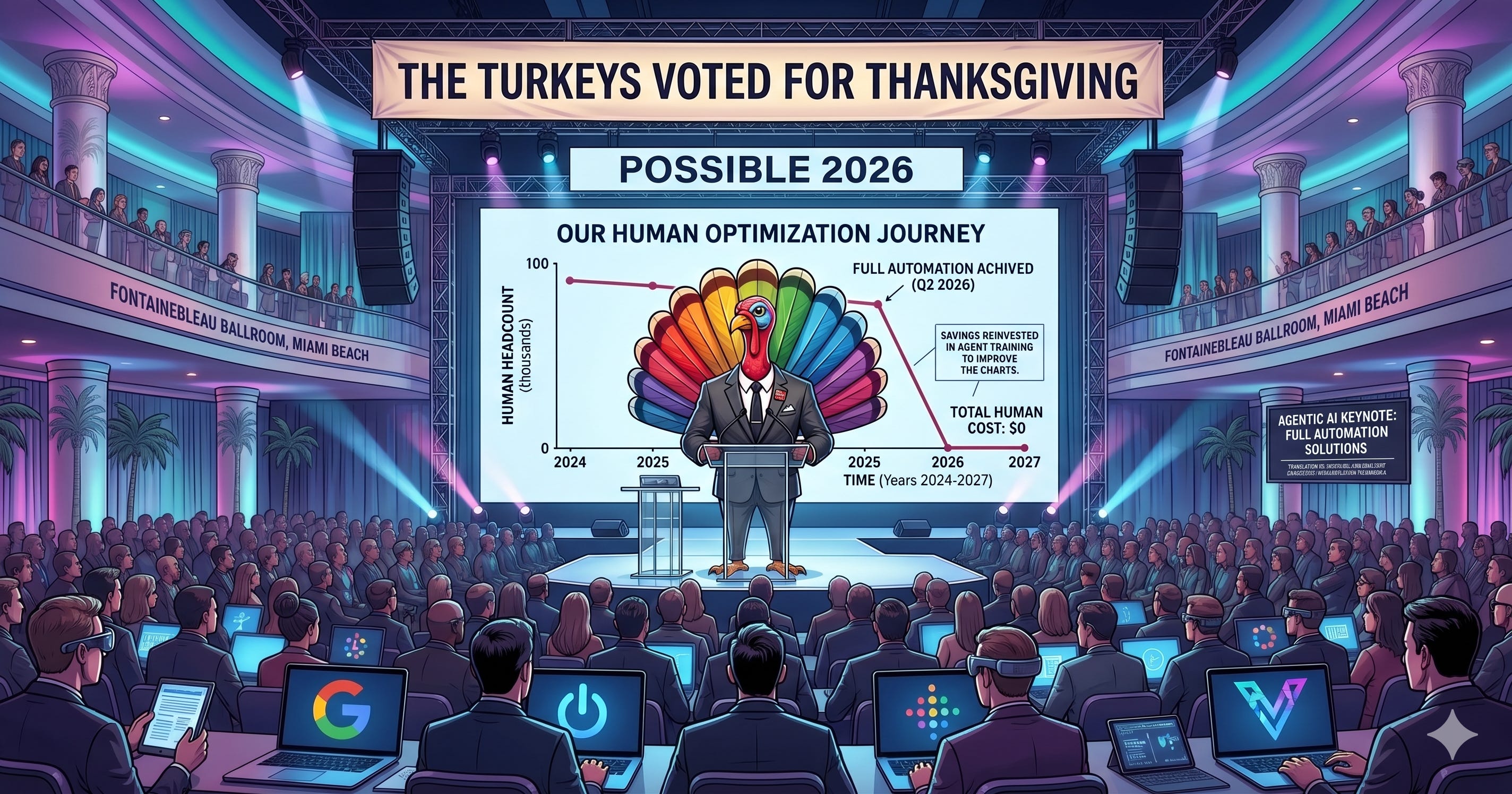
The Latin verb is agere. It means to act on behalf of another. From it comes “agent”: a person who acts on behalf of a principal. From it comes “agency”: a company staffed with such people. And from it, in 2025, came “agentic”: the adjective the technology industry chose for software that autonomously receives instructions, makes decisions, and executes tasks without a human at each step.
Same root. Same meaning. Different invoice.
Advertising agencies have been charging clients for agere since the 1840s. An AI agent running on Claude or Gemini does agere at machine speed, around the clock, for the price of a cloud bill. Either somebody in the etymology department was not paying attention, or somebody was paying very close attention and assumed the industry would not notice.
The industry noticed. The industry gave it a standing ovation.
That was Miami Beach, late April 2026. POSSIBLE 2026, the adtech Global conference at the Fontainebleau hotel, where a badge costs $2,995 and the agenda had no session titled “Should Agencies Be Afraid.” The sessions had better titles. “The Future of AI-Powered Marketing.” “Agentic AI and the CMO of Tomorrow.” The conversations between sessions were considerably more anxious.
Jeff Green, CEO of The Trade Desk, took the main stage with media executive Michael Kassan and delivered the most precisely calibrated statement of the conference. “You can’t keep taking money out of the middle,” he said, “providing a higher level of service in a more complicated ecosystem, and do that for less and less.” He called this moment “one of the greatest opportunities that I think any of us will ever see in this space.” He described the ad supply chain as being “cleaned up,” with fewer tolerated “toll collectors in the middle.” The agencies in the audience nodded. They understood what he was describing. They did not applaud that specific sentence.
In the same week, at Marketecture Live in New York, Green confirmed to Ari Paparo that The Trade Desk is running a closed beta allowing some advertisers to create campaigns directly through Anthropic’s Claude, with no human media planner configuring the platform.
Sympathy for the agencies in Miami. A tool that bypasses them in New York. Same person. Same week.
A few days after POSSIBLE ended, Daniel Miessler, founder of Unsupervised Learning, published a post on May 2, 2026 titled “Most Companies Aren’t Anywhere Near Ready for AI.” He was not writing about adtech specifically. He did not need to. “A massive percentage of companies are haphazardly successful despite themselves,” he wrote. “AI can do basically nothing for these companies. In fact, it could make it worse, because now it helps people flail more impressively. Like with more backflips and charts and stuff.”
The companies succeeding with AI, he observed, are “somehow magically the same companies that already know what they are doing” and can describe their goals, workflows, metrics, and costs clearly and consistently. Adtech holding companies have never found those questions easy to answer at the best of times.
This is the industry and this is the moment.
What the Conference Stage Says vs What the Trading Desk Does
Before the paradox can land properly, the technology needs to be described precisely, because the version on most conference stages is about 40% accurate and 60% aspiration.
Most companies right now are deploying conversational AI. You type a query. It answers. You ask it to draft a brief. It drafts. A human reviews every output before anything happens in the real world. Useful. Not agentic.
An agentic AI system works differently at the architecture level. The large language model, whether Claude, Gemini, or GPT-5, serves as a reasoning core that receives a high-level objective, decomposes it into sequential sub-tasks, calls external tools and APIs, observes the results, and re-plans when something fails, all without a human prompt at each step. The human sets the goal once. The system executes every step.
In advertising, the technical interface is Anthropic’s Model Context Protocol, released late 2024. MCP is a standardized connector that lets an LLM communicate securely with external systems: a publisher’s inventory API, a DSP’s bidding endpoint, a data clean room, a measurement dashboard. Write one MCP-compliant server and any MCP-compatible AI agent can talk to it, without a bespoke integration for each platform.
The Ad Context Protocol, launched October 15, 2025 by Scope3, Yahoo, PubMatic, Triton Digital, Optable, and Swivel, is built directly on MCP. A buyer’s AI agent sends a natural language brief. “Find premium video inventory, in-market auto buyers, Southeast Asia, 25-34, $18-22 CPM, Q3, $500,000 budget.” The seller’s AI agent packages available inventory, audience match rates, and pricing into a structured response. No insertion order email. No RFP sitting in an inbox for three days. No account manager on hold. The transaction is asynchronous and can accommodate a human approval loop, but the operational overhead is gone.
This works. In specific, constrained, production situations. Butler/Till, an independent agency, ran a December 2025 campaign for the beverage brand Clubtails using PubMatic’s AgenticOS powered by Claude. AI recommended tactics, executed media buys, and optimized in real time. Butler/Till described this as freeing their team for “higher-value strategic planning, creative development, and measurement.” Which is exactly the right framing. It is also worth asking: what specifically was the human doing during that buy that the AI could not have done without them? That question was not on a POSSIBLE panel. It is the only question that matters.
IAB Tech Lab’s Agentic RTB Framework, released for public comment November 2025, is technically distinct from AdCP and constantly conflated with it. Where AdCP automates deal negotiation above the auction, ARTF uses containerization to put third-party AI agents inside the auction itself. A fraud detection agent does not sit in a remote data center reviewing impressions post-bid. It runs inside the DSP at sub-millisecond latency, before the bid fires. The host platform gets the output without seeing the agent’s code. Anthony Katsur’s stated target: up to 80% reduction in bid request and response latency by eliminating cross-network data center hops. The Trade Desk, Netflix, Paramount, Yahoo, Index Exchange, and Chalice have all expressed support.
AdCP and ARTF are at different layers and do not technically conflict: AdCP above the auction, ARTF inside it. In principle they are complementary. In practice they represent competing governance structures and different commercial interests. AdCP is governed by the new Agentic Advertising Organization with Brian O’Kelley and former IAB CEO Randall Rothenberg on the interim board. O’Kelley built Right Media (sold to Yahoo) and AppNexus (sold to AT&T, eventually becoming Microsoft Invest). His track record is building infrastructure that becomes a market standard and generates substantial commercial value for its architects. That is context, not accusation.
Google, The Trade Desk as a full AdCP signatory, and Amazon DSP have not joined the AdCP consortium. When those three sit out, “industry standard” is an aspiration. ARTF has broader institutional support from the platforms that process the majority of programmatic volume. Katsur told The Current: “We are a shiny-penny industry, and agentic is a shiny penny, but I don’t think it’s blockchain. There is something of substance there.” The substance in ARTF is engineering-level. The substance in AdCP for creative workflow automation is real. For media buying at scale, it is running into the same structural walls Ari Paparo documented when he tried to build this at Google in 2010 and described again in his November 2025 Marketecture analysis: buyers won’t be price takers, sellers won’t reveal real rate cards, small publishers lack the data scale to deliver meaningful performance, large publishers have no incentive to automate their best inventory relationships. These are incentive problems. AI executes faster through them. It does not dissolve them.
Gartner published a formal prediction in June 2025: over 40% of agentic AI projects will be canceled by end of 2027 due to escalating costs, unclear business value, or inadequate risk controls. “Most agentic AI projects right now are early-stage experiments or proof of concepts that are mostly driven by hype and are often misapplied,” said Anushree Verma, senior director analyst at Gartner. Of thousands of vendors claiming agentic capabilities, Gartner estimates around 130 have genuine ones. The industry has a name for the rest: “agent washing.” We replaced greenwashing with agent washing without pausing for breath. McKinsey research found that while nearly two-thirds of enterprises have experimented with AI agents, fewer than 10% have scaled them to deliver measurable value.
This is the gap between the conference stage and the trading desk.
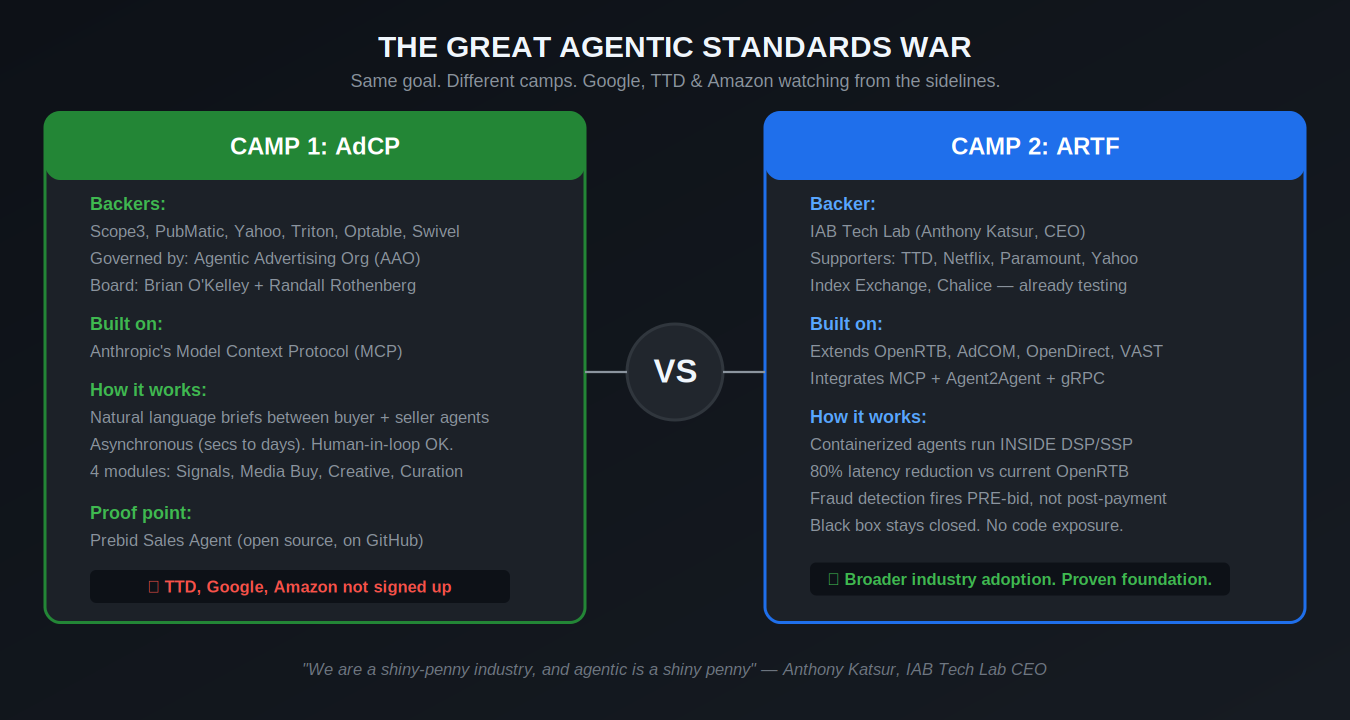
ARTF vs AdCP: different layers, different camps, and the three platforms processing most of global programmatic volume are not in the AdCP room.
The 36-Cent Scandal That AI Will Now Run at Machine Speed
The principal-agent problem is a foundational concept in economics. A principal hires an agent to act on their behalf. The agent has private information the principal does not have. Their interests can diverge. The agent can exploit that gap. The classic undergraduate textbook example is the advertising agency. This is not a metaphor. It is in the textbooks.
Agencies earn a percentage of media spend. Their financial incentive is to spend more, not less. They often have supply relationships with certain SSPs, exchanges, and data vendors that are not always fully disclosed to clients. The ANA’s December 2023 Programmatic Media Supply Chain Transparency Study quantified this formally, tracking $123 million in ad spend across 21 major brands between September 2022 and January 2023. Finding: only 36 cents of every dollar entering a DSP reached the consumer. Transaction costs, primarily DSP and SSP fees, consumed 29 cents. Non-viewable, non-measurable, fraudulent, or made-for-advertising inventory took 35 cents. Agency fees and brand safety costs were explicitly out of scope, meaning 36 cents is the optimistic version of the story.
The industry knew. It preferred clients not have those specific numbers in a published research report.
Now put agentic AI on top of this.
Vinny Rinaldi is VP of Media and Marketing Technology at Hershey, overseeing north of $2 billion in combined media and trade marketing investment. He is an operator, not a conference pundit. In a LinkedIn comment thread this year that circulated widely across the industry, he wrote the most important single paragraph produced by adtech in 2026:
“Whoever builds the agent sets the objective. And the objective reflects their economics, not your own. If you don’t own the data the agent is trained on, you don’t control what it’s optimizing for. A CPM will look neutral and a margin target doesn’t show up in the report. We’ve been asking for transparency since 2014. What we actually need is ownership of the input layer before the agent ever makes a decision.”— Vinny Rinaldi, VP Media & Marketing Technology, The Hershey Company
This is not a complaint about technology. It is a precise description of how the principal-agent problem migrates into an AI system. If an agency builds the client’s agentic stack, the agency sets the objective function. If that objective includes preferences for supply partners where the agency has financial relationships not disclosed to the client, those preferences travel silently into the algorithm. The AI produces CPMs and reach figures that look neutral. The misalignment runs at machine speed. The audit trail points at a model, not a meeting.
This is a worse version of the transparency problem, not a better one.
Hershey’s practical response is the most instructive production case study in adtech right now. The company built agentic marketing mix modeling using Mutinex and Tracer, running on Claude and Gemini, using its own data, through analytics partners it controls directly. “We were getting the full read of 2024 data midway through 2025, while we were planning for 2026,” Rinaldi told Adweek. Always-on agentic MMM compresses the lag from annual to monthly. “You take all of our trade dollars into account, anywhere from two plus billion dollars of investment, you can now start to make decisions off of on a monthly basis.” The agency that previously delivered the annual readout on PowerPoint, six months after the data had passed its use-by date, is not in this workflow.
Ari Paparo served at Google’s DoubleClick business, where he was responsible for products sold to agencies and advertisers, before co-founding Beeswax, a DSP he sold to FreeWheel, and then founding Marketecture. He is methodical about distinguishing where agentic AI works from where it runs into structural walls. On creative workflow automation, he is genuinely positive: AdCP’s creative protocol solves a real, time-consuming, human problem. On media buying, he returned to his 2010 experience at Google in his November 2025 Marketecture analysis: “Buyers don’t want to be price takers. Sellers don’t want to reveal their rate cards.” His conclusion: “The use of agents ends up being more appropriate for reinforcing the role of intermediaries, rather than enabling a breakthrough to empower buyers and sellers.”
AI makes the middlemen faster. It does not make them unnecessary. Unless they have nothing left that only they can provide, which leads directly to what Green said in New York.
What $150 Million Says About Where AI Value Accrues
In March 2026, Jeff Green purchased approximately $150 million of Trade Desk stock personally. The Trade Desk reported $2.896 billion in 2025 revenue, with growth decelerating to 18% year-over-year, and Q1 2026 guidance came in below analyst expectations. The market was pricing genuine uncertainty about what large language models mean for a programmatic DSP.
Green’s thesis, delivered across a LinkedIn post, a detailed blog essay, and a Marketecture Live session with Paparo: “Agentic AI will accrete the most value to companies that already have deep customer trust, that have scaled, refined and objective datasets, and that prioritize objectivity.” He cited scale as the reason programmatic is uniquely suited to AI: 20 million ad impression opportunities every second, decisions required in 10 milliseconds or less. “I don’t think there is an industry in the world that is more conducive to AI than programmatic advertising.”
At POSSIBLE, Green described “complexity” as no longer being “an excuse for opacity.” The supply chain, he said, is being “cleaned up,” with fewer tolerated toll collectors. Which brings us to the subplot that is almost too neat. Adweek reported in February 2026 that Dentsu and WPP had quietly exited The Trade Desk’s OpenPath direct publisher program, citing transparency concerns and what they described as hidden fees. OpenPath was designed specifically to create a more transparent supply path. Green, the industry’s loudest critic of supply chain opacity, found himself accused of opacity by the agencies he critiques for opacity. In adtech, everybody is somebody else’s toll collector, and everybody else’s toll collector is a “trusted partner.”
Paparo’s April 2026 Marketecture piece distilled DSP survival to exactly two variables: unique data and unique inventory. “That’s it. I didn’t make this up. It was told to me over and over by not one, but tens or hundreds of potential buyers.” If agentic AI automates every execution function a DSP differentiates on today, the moat is what remains. Every DSP without proprietary data or exclusive supply has already lost the argument. The invoice just has not been itemized yet.
Google and Amazon Are Not Applying for Conference Panels
Google, Meta, and Amazon together controlled 54.7% of the global digital advertising market in 2025, according to WARC’s Global Ad Forecast. Their combined share is forecast at 56.2% in 2026. They are building agentic advertising infrastructure on their own terms, inside their own ecosystems, with no requirement to participate in any open standard.
Google’s AI Max, its AI-based bidding product for search and shopping, was described by AdExchanger’s on-the-ground POSSIBLE 2026 coverage as having “hundreds of thousands” of advertisers using it. Google’s Universal Commerce Protocol, co-developed with Shopify, Walmart, Target, Etsy, Wayfair, and more than twenty other partners, creates an agentic checkout layer inside Google’s AI surfaces. A consumer describes what they want in Gemini or AI Mode in Search. The agent handles research, comparison, and purchase without leaving Google’s environment. No open web ad placement. No DSP bid. No agency media plan.
Amazon owns the transaction data, the inventory across streaming and display and retail media, and increasingly the AI that bridges them. Amazon’s figures for its Rufus shopping assistant showed a 60% increase in purchases per session among customers who used it in Q3 2025. For advertisers whose primary metric is ROAS with closed-loop attribution, Amazon offers a complete system in which AI handles discovery, targeting, delivery, and measurement inside one platform that also owns the transaction. The open web cannot replicate this structurally.
Anthropic’s run-rate revenue passed $30 billion in 2026, up from approximately $9 billion at end of 2025. Over 1,000 enterprise customers are each spending more than $1 million annually. Claude is available simultaneously on AWS Bedrock, Google Cloud Vertex AI, and Microsoft Azure. The same reasoning engine is embedded in The Trade Desk’s campaign creation beta, in PubMatic’s AgenticOS, and in Hershey’s MMM platform at the same time.
The open web’s strategic response to all of this: two competing protocols, monthly standards boot camps at the IAB Ad Lab, and a public webinar on the roadmap. WARC’s data shows walled gardens absorbing roughly 1.5 percentage points of global ad spend from the open web per year. Agentic AI does not correct that trajectory. It accelerates it. The environments that benefit most from fully autonomous execution are the ones with closed data loops. Those are the walled gardens. The open web can close individual transactions. It cannot close the loop.
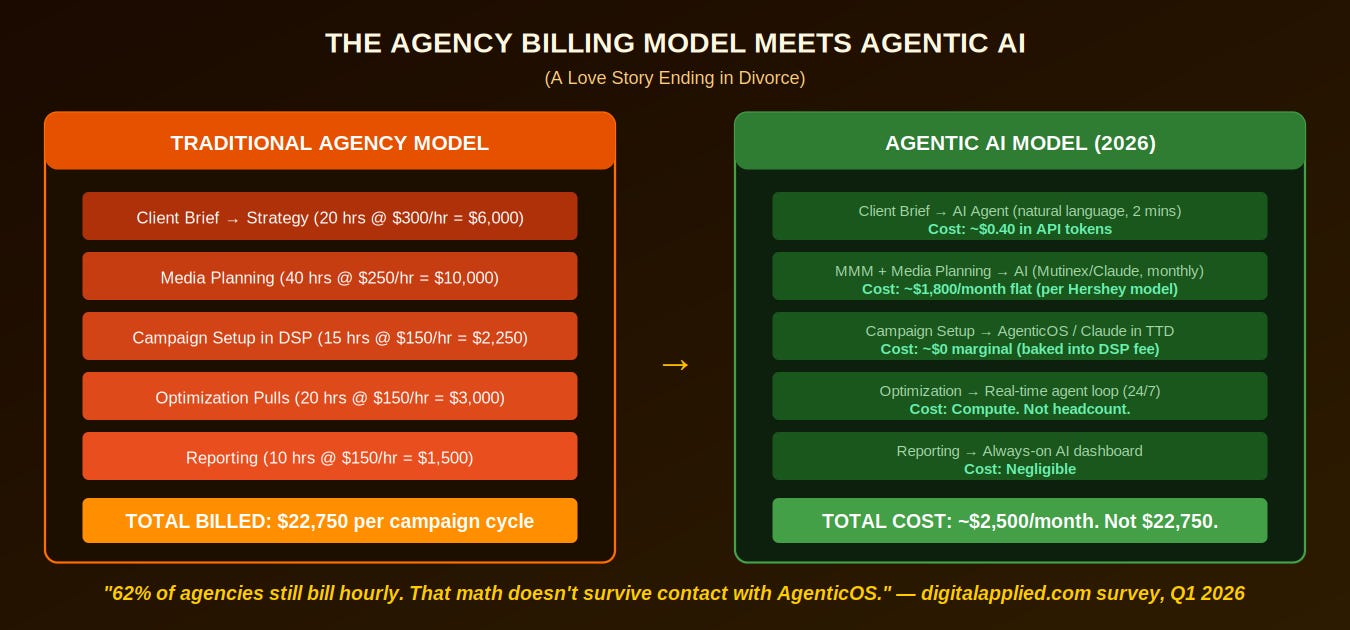
The billing math most agency principals are not running in client conversations. AI-native competitors are pricing 20-30% below traditional cost basis on the same deliverables.
Eight Ways an Agency Gets This Wrong, With Numbers
At CES 2026, WPP launched Agent Hub inside WPP Open, a curated marketplace of “Super Agents” working across client briefs. Omnicom unveiled Omni as an agentic AI operating layer. Both announcements received applause from audiences that included employees whose jobs those systems are being built to eventually handle. The cognitive dissonance in the room was something you could almost measure.
A Q1 2026 survey of 250 agencies by digitalapplied.com catalogued eight structural failure modes in adtech agency AI adoption. The most consequential:
62% of mid-market agencies still bill by the hour. Agentic delivery compresses production task completion time by 80-90%. An agency using AI to do in two hours what previously took twenty, and billing hourly, has destroyed 90% of its revenue on that engagement without a single conversation about repricing. The repricing conversation is also the “why exactly do you still need us at this margin” conversation. Most agency principals are choosing not to have it.
Only 11% of mid-market agencies have a mature evaluation harness: the systems to measure whether their AI output is better than the output a platform produces natively for free. Without this, the margin argument collapses the first time a client asks the question.
34% utilization of agentic engineering talent hired by agencies. The engineers landed in innovation labs, adjacent to the production teams that actually need the capability rather than integrated into delivery. Expensive headcount generating impressive slide decks while client work runs on human labor and monthly retainer.
Omnicom has been the most candid holdco about the underlying logic, which is worth acknowledging. CTO Paolo Yuvienco said at POSSIBLE that Omnicom has already “tested the pipes” with AdCP and run agent-to-agent media buys for several clients. The goal, he said: move budget into “working media” and less into “the machinery around it.” The machinery he wants to eliminate is operated by middlemen. The joke is that Omnicom is the machinery. It is automating its own operational layer and describing this as a competitive advantage. Even they cannot say it with a straight face in private.
WPP’s market cap fell from roughly £25 billion in 2016 to below £3 billion by early 2026. Dentsu cut 8% of its global workforce. WPP’s Elevate28 plan targets £500 million in gross cost savings by 2028. That saving is not coming from renegotiating server contracts.
Four Things Worth Paying Agency Margin For, Honestly
Not everything is being automated. Stating otherwise would be analytically lazy.
Original creative strategy. Not execution. Not variant generation. The upstream brief that explains why a brand occupies cultural space no competitor can easily claim. AI generates ten thousand variants and optimizes them programmatically. It did not write the brief that made those variants worth making. Hershey’s “Holiday Bells” campaign is 35 years old. Rinaldi used agentic AI to compress measurement cycles to monthly. He did not use it to write the brief that made 35 years of a campaign possible.
Navigating client organizations. A media strategy exists inside a political ecosystem: CFO risk tolerance, CMO career ambitions, procurement history, board quarterly expectations. Navigating those forces and serving as a credible external voice when internal consensus breaks down is irreducibly human. AI surfaces the analysis. It cannot read the room.
Building first-party data infrastructure. Rinaldi’s “input layer” argument cuts both ways. Agencies helping clients build clean, structured, activated first-party data through clean rooms, identity resolution, and direct publisher partnerships are creating infrastructure with compounding value. The AI needs the data. Someone has to build it. Genuine defensibility here, with one strict caveat: it only works if the agency does not hold the data in a way that recreates the conflict of interest Rinaldi described.
Independent measurement. As AI agents run campaigns autonomously and produce reports that look neutral, brands need someone they trust to audit those reports. A genuinely independent measurement function, structurally separated from any undisclosed supply relationships, that validates AI-generated outcomes against real business results, has growing and underserved demand. The agencies capable of providing it are the ones that have already given up the margin games that make structural independence impossible. That is a small group. It will be a valuable one.
These four things are not what most holdco agencies currently charge premium margin for.
The Bill
Agentic AI did not create the crisis in the adtech agency model.
Twenty years of opacity, principal-based buying, and undisclosed supply relationships created the crisis. The ANA’s 2023 study quantified it precisely: 36 cents per dollar reaching consumers from a DSP, 29 cents to transaction costs, 35 cents to low-quality or fraudulent inventory, and agency fees out of scope. The industry knew. It preferred clients not have those numbers in a published research report with a methodology they could audit.
Agentic AI is the mechanism through which clients will finally have an alternative that does not require trusting the intermediary to report honestly on its own performance. Jeff Green called this “one of the greatest opportunities that I think any of us will ever see in this space” at POSSIBLE. He is right. The opportunity is not equally distributed. It belongs to the entities with unique data, closed measurement loops, and the technical capacity to run AI against real business outcomes. It does not belong to companies whose primary competitive advantage is complexity. Complexity can now be routed around, at roughly 1.5 percentage points of global ad share per year and accelerating.
Miessler’s observation from May 2026 applies to adtech with surgical precision: the companies succeeding with AI are the ones that already know what they are doing and can describe it clearly. The ones that cannot will use AI to fail more impressively, with better charts and more confident keynotes.
The Latin word at the center of all of this is agere.
An industry named after human agents is building software agents to do what human agents do. It is presenting this as transformation. It is charging for the transition. It is convening annual conferences with $2,995 badges to discuss when it will be complete.
For the production layer of agency work, the answer is already.
The turkeys voted for Thanksgiving. They named the stuffing “Agentic AI.” They organized a panel about it at the Fontainebleau and charged $2,995 to attend.
The caterers have been booked.