

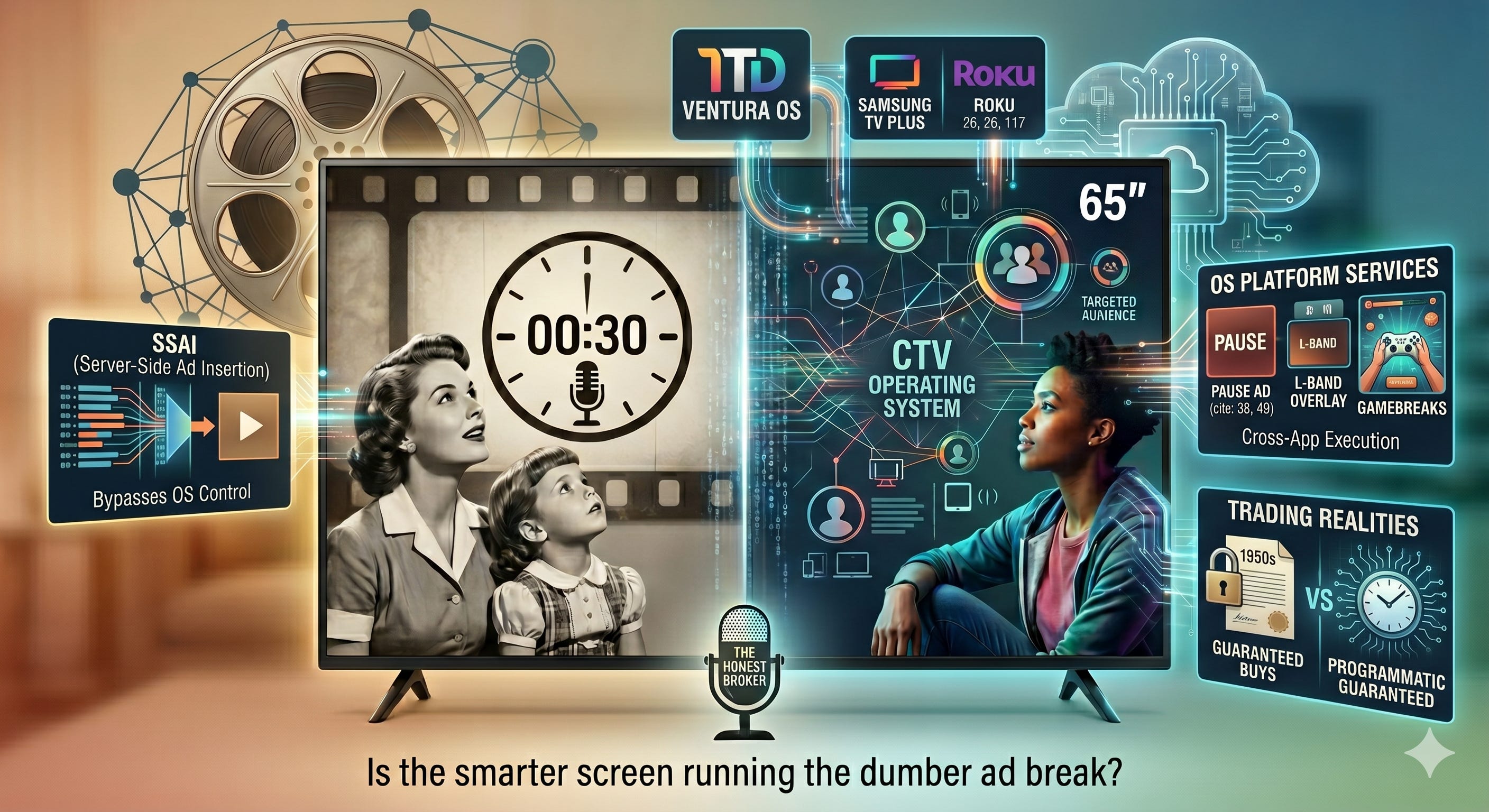
Every May, New York City hosts its most elaborate annual performance in advertising. This year is no different. NBCUniversal is back at Radio City Music Hall on May 11, where it will celebrate the 100th anniversary of the NBC broadcast network while also, quietly, selling guaranteed ad inventory for the coming television season to the same agencies that have been buying guaranteed inventory in this same ritual since the 1950s. YouTube’s Brandcast takes over Lincoln Center on May 13. Disney, Amazon, Netflix, and approximately three dozen others follow across two weeks of open bars, celebrity appearances, and sizzle reels. The IAB moved its NewFronts to March this year, which means programmatic companies had their moment slightly earlier, but the same cast of DSPs, SSPs, measurement vendors, and ad-tech platforms are still in the room at every upfront presentation, standing alongside the streamers, claiming that programmatic CTV has finally arrived.
It has not, or rather it has arrived in the same way that a passenger train has arrived at a station that still uses 1950s ticketing infrastructure. The ride is smoother. The engine is quieter. The seat is more comfortable. The ticket still has to be bought at the window, in advance, at a fixed price, negotiated between human beings who then confirm the transaction over email. The programmatic revolution in television is real at the infrastructure level and largely theater at the commercial level. Understanding why requires understanding something that almost nobody in those hotel ballrooms will say out loud: that the operating system of the television set is now the most powerful piece of commercial infrastructure in modern advertising, that the companies who built it are using it to concentrate supply in ways that would give an economics professor pause, and that one of the most credible attempts to challenge that concentration is being made by The Trade Desk, which saw the problem clearly, built Ventura as a direct response, and now faces the question of whether its current architecture is sufficient to actually shift the balance of power.
Let us be specific about what is happening, and why it matters.
Who Controls Supply Controls the Market. The OS Companies Figured This Out First.
Before the technology, the economics. The television advertising market is, at its core, a supply and demand problem that has taken on a peculiar shape that standard market equilibrium theory was not quite designed to describe.
In a perfectly competitive market, producers set prices based on their costs, buyers choose among identical goods, and the market clears at an equilibrium where supply equals demand. Television advertising is not this market. Premium CTV advertising inventory is not a fungible commodity. A 30-second slot in an NFL playoff game on Peacock is not interchangeable with a 30-second slot in a FAST channel running reruns at 2am, even if both arrive in the same programmatic pipe. The playoff slot is scarce, contextually valuable, and brand-safe in a way that the advertiser will pay a substantial premium to obtain. Simulmedia has documented that premium CTV publishers price their inventory at two to six times the CPM of national linear television. The premium is not arbitrary. It reflects genuine scarcity of the contextual environment that major brand advertisers require.
In oligopoly theory, when a small number of suppliers control the majority of a scarce good, those suppliers hold market power. They can price above competitive equilibrium, restrict supply to maintain that premium, and structure the market to make substitution difficult. This is precisely what has happened in premium CTV inventory, and the operating system is the mechanism through which it has been achieved.
An AdExchanger investigation published in November 2025 documented the specific mechanics. Many OEMs and streamers take as much as half of a publisher’s ad inventory by contract. They aggregate that share, repackage it as premium direct supply, and label the remainder as lower quality, even when the audience, content, and impression value are identical. I remember SpringSever Ad Server (now acquired by Magnite) even built a feature called “Inventory Router” that adapted the revenue sharing between content producers, distributors, OEMs, and other partners. Like the first ad in the ad pod belonged to HBO, the next one was Roku. The same ad break, the same household, the same moment of viewer attention, is classified as premium or remnant based entirely on which entity controls its sale. The entity that controls the OS controls the classification. The entity that controls the classification controls the price. The same OS operators also decide which bidstream signals are visible to external buyers. When impressions flow through the OEM’s own auction, data is abundant: genre, device ID, IP address, viewing history, household demographic. When publishers sell through independent channels, those signals often disappear or are sold back to the publisher as a fee-bearing add-on. Missing data depresses bid density even on quality inventory, further suppressing yields for publishers who try to operate outside the OS operator’s commercial architecture.
Tatari’s CEO Philip Inghelbrecht made the concentration point directly in a March 2026 interview: 90 percent of all streaming impressions placed for brands and agencies come from the same top ten publishers. In sports, anything that looks and smells like a playoff or a bigger game is not going to be found on The Trade Desk as an example. That inventory is sold directly, by publishers who prefer it that way and will only sell it that way, because the economics of direct selling are better than the economics of open-exchange bidding at these CPM levels. Jounce Media’s data adds a dimension to this: approximately 125 million US streaming devices per month flow through trusted direct supply chains. Tens of millions of additional devices appear in the bidstream through ad networks reselling inventory from other networks. Jounce’s conclusion is unambiguous: there are two types of resold CTV auctions, those that waste 20 percent of a marketer’s budget and those that waste 100 percent. The premium inventory that every advertiser actually wants exists in a concentrated, controlled environment. The open bidstream that DSPs access is partly real and partly fabricated.
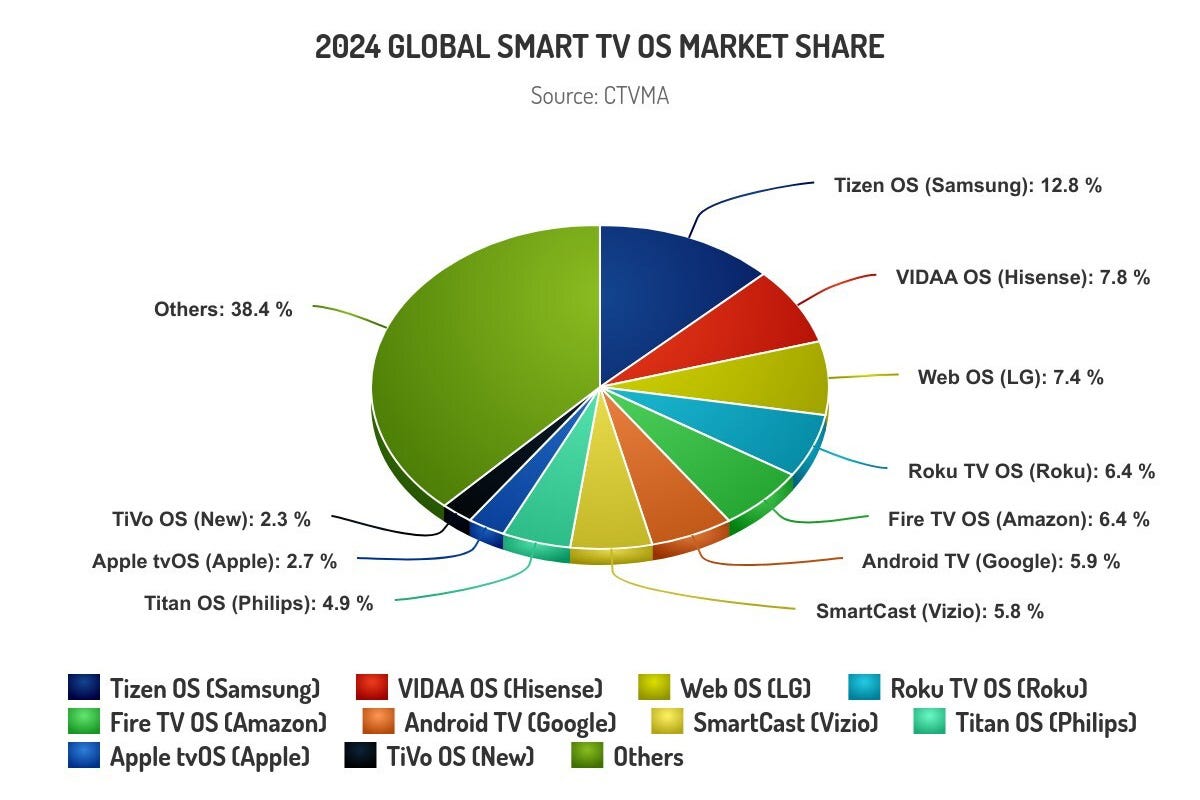
This is the supply control problem in CTV, and it is the problem that The Trade Desk’s Ventura is designed to address. The architecture Ventura has chosen focuses on programmatic transparency: OpenPath for direct supply connectivity, Unified ID 2.0 for privacy-preserving identity, OpenAds for auction fairness, and OpenPass for single sign-on authentication. The Ventura Ecosystem, launched in February 2026 with V, the operating system formerly known as VIDAA powering more than 50 million Hisense and Toshiba devices globally, and Nexxen as founding collaborators, attempts to open the supply chain by giving OS partners direct access to this programmatic infrastructure. The logic is internally consistent and the ambition is real. Whether the current emphasis is sufficient to shift structural market power is a different question, one this article will return to.
What the Old Box Knew That the New Screen Has Forgotten
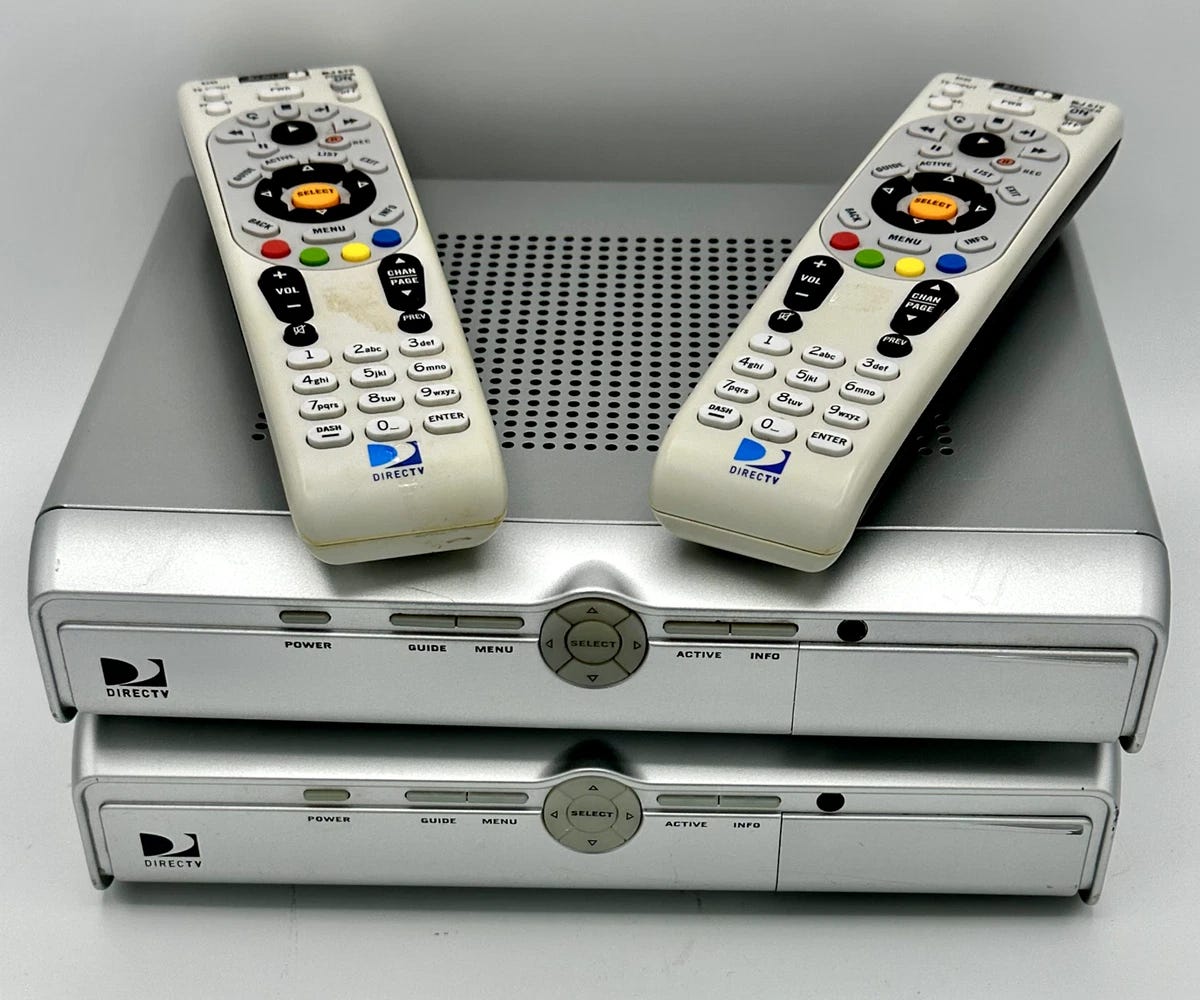
For most of television’s commercial history, the set-top box was the advertising infrastructure. NDS Group, founded in 1988 by scientists from the Weizmann Institute of Science and later acquired by Cisco in 2012 for approximately 5 billion US dollars before being spun out as Synamedia in 2018, built the conditional access systems and middleware that processed every signal from broadcaster to screen. Its VideoGuard conditional access system protected content in more than 114 million pay-TV households. Its MediaHighway middleware ran in more than 180 million set-top boxes cumulatively. The name changed when it became Synamedia. The structural problem it was built around, which is how video content reaches screens and who controls that process, remained.
The set-top box operator had something that no smart TV OS operator has fully replicated: sovereign control over the complete signal chain from content ingest to screen display. Content came in, the box processed it, the box modified the ad break, the box rendered the result. At no point did the operator need an application’s cooperation, a publisher’s SDK, or a streaming service’s agreement to implement a format. Sky’s AdSmart in the United Kingdom, launched in 2012, was delivering household-level addressable advertising in live linear broadcast when Netflix’s ad tier did not exist. Germany’s SevenOne Media and RTL Ad Alliance were running dynamic ad insertion in linear streams through set-top box software as early as 2016. The credit squeeze, where a broadcaster compresses end credits into a smaller window to create advertising space alongside, and the L-band overlay, where an advertisement occupies the left side and bottom of the screen while content continues in the remaining window, were deployed in broadcast environments using this architecture before most streaming executives had heard the terms.
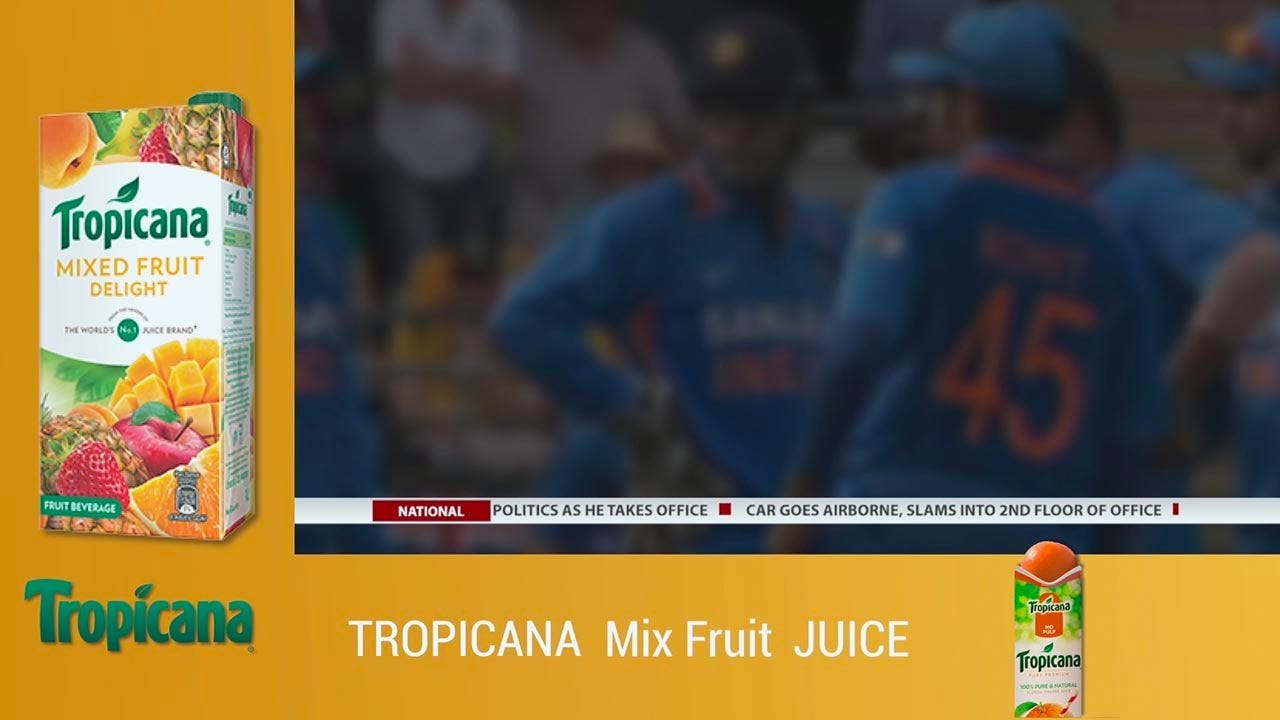
The smart TV era disrupted this architecture without replacing its most important commercial capability. The television manufacturer now runs the operating system. Applications from Netflix, Disney, Peacock, and hundreds of others run on top. Content arrives through those applications. But the OS manufacturer does not control the video rendering pipeline of a Netflix stream the way a set-top box operator controlled the signal. The OS controls the home screen, the device identifier, what runs natively, and what data passes through at the device level. Formats like squeezeback require modifying the displayed video frame in real time, which requires either the streaming application to implement it deliberately or the OS to have rendering-pipeline control over third-party video playback that most smart TV platforms have not built as a cross-application service.
Roku’s position in this story is worth examining specifically because it is the most structurally interesting of any company operating in CTV advertising today. Roku is simultaneously a partner and a competitor to almost everyone. It maintains a UID2 data integration and supply partnership with The Trade Desk, while also operating OneView, its own DSP that directly competes with The Trade Desk. It struck a deal with Amazon in June 2025, announced at Cannes Lions, giving Amazon DSP exclusive access to Roku’s OS-level audience signals, creating combined reach across an estimated 80 million US CTV households, while Amazon Fire TV is Roku’s largest device-level competitor. It licenses its OS to TCL and Hisense, who are also being targeted by The Trade Desk’s Ventura Ecosystem. Roku reported approximately 85 million active accounts and platform revenue of approximately 2.7 billion US dollars in 2024, the majority from advertising. Nobody in CTV advertising can ignore Roku. Nobody can fully trust or fully rely on it either, which is a structural characteristic that has suited Roku quite well.
What the Publisher Can Control and What Belongs to the OS
One of the more consequential misunderstandings circulating in CTV discussions is the assumption that individual streaming applications, if sufficiently motivated, can implement the full range of advanced advertising formats on their own. They cannot, and understanding precisely where the capability boundary falls explains why OS-level solutions matter and why fragmentation has proven so persistent.
A streaming publisher operating its own application on a smart TV has genuine capabilities that are often underutilized. Within its own app, a publisher can implement pause ads by detecting when the viewer presses pause on the remote and triggering a full-screen or partial-screen ad overlay through its own player UI layer. Publishers like Netflix, Peacock, and Hulu have done this. A publisher can overlay QR codes on its creatives using its own rendering layer. It can run shoppable ad formats within its own content environment, allow viewers to interact with branded elements via remote, and optimize dynamic creative for its own first-party audience data. For in-stream ad replacement, any publisher that controls its own playout pipeline can use server-side ad insertion to replace ad slots dynamically, managing creative quality normalization and audience targeting within its own infrastructure. A publisher can also control frequency capping within its own application, prevent competitive adjacency within its own ad breaks, and report viewability from its own measurement instrumentation.
What a publisher cannot do unilaterally is substantial. Cross-application frequency capping requires OS-level visibility, because the application has no signal about what another application has already delivered to the same household in the same viewing session. Home screen placements, the highest-attention inventory on any device, are owned entirely by the OS operator and are not available to third-party publishers. Device-level ACR data, which captures viewing behavior across all inputs connected to the television regardless of which application or source is active, is collected and controlled by the OS manufacturer. This data is what makes Samsung Ads and LG Ad Solutions able to offer cross-platform audience intelligence that no individual streaming publisher can replicate. Screensaver ads, which run when the television is idle and no application is active, are OS-initiated events that individual publishers cannot control. Menu ads, which integrate into the TV’s navigational interface, are OS-owned surfaces entirely.
The formats that fall in the middle are the most interesting. A squeezeback, which reduces the content frame to approximately 60 percent of screen size while displaying an advertisement alongside, requires modifying the primary video display in real time. If the streaming application controls its own video player and has implemented the format within its own app, it can do this. But it must build this for every platform separately, because each OS has different rendering characteristics and different player implementations. There is no shared service. A pause ad that works precisely on Disney+ requires Disney to build it for Samsung’s Tizen, then build it again for LG’s webOS, then for Roku OS, then for Amazon Fire TV, then for Google TV. Standardization reduces the specification debate, but it does not eliminate the implementation work. An OS operator that built squeezeback, overlay, and L-band delivery as a cross-application platform service would eliminate that duplication for every publisher on its platform simultaneously.
Six Formats Standardized in December. Still Barely Deployed in April.
In December 2025, the IAB Tech Lab published its CTV Ad Portfolio establishing technical specifications for six advertising formats that exist outside traditional commercial breaks: pause ads, menu ads, squeezeback, overlay, in-scene insertion, and screensaver ads. The IAB collected more than 100 format descriptions from over 40 companies, including Disney, NBCUniversal, FreeWheel, Google, Yospace, The Trade Desk, and Tubi, as part of its Ad Format Hero initiative begun in 2024. The specifications went to public comment until January 31, 2026.
A TripleLift report published in March 2026 found that 49 percent of CTV advertising impressions are still delivered as traditional 30-second or 15-second spots. The same report found that campaigns combining high-impact formats with standard spots delivered 33 percent higher brand recall, 11 times higher brand consideration versus industry benchmarks, and 76 percent higher purchase intent. Engagement rates for interactive CTV formats reached 1.94 percent in Q2 2025 according to eMarketer, nearly double the rate from Q2 2024. Shoppable CTV formats have been measured converting at five times the rate of standard video in some deployments. The evidence that these formats outperform the dominant creative format is not ambiguous. The industry continues to run the dominant creative format.
The reason is partly commercial inertia and partly a genuine technical barrier. The commercial barrier is that 15-second and 30-second spots require no new creative production, no new agency workflow, no platform-specific integration, and no explanation to the client. The technical barrier is that advanced formats delivered consistently across every CTV platform require either OS-level implementation as a platform service or per-publisher implementation that must be repeated for every platform. Samsung’s GameBreaks, launched in 2024, are interactive ads that convert commercial breaks into branded mini-games within Samsung TV Plus, Samsung’s own FAST channel. They work because Samsung controls both the OS layer and the content layer within TV Plus. DirecTV Advertising’s SVP of Product noted in 2025 that pause ads showed strong results but advertisers were not scaling them in part because of the custom creative work required across different platform implementations. The IAB’s build-once, serve-everywhere aspiration for the six standardized formats is correct as a direction. Getting every OS operator to implement those standards uniformly requires each platform to deprioritize its own proprietary implementations long enough to build something that benefits competitors alongside its own channels.
Why Television Still Sells Itself in Upfronts, and What Video Technology Has to Do With It
The upfront market’s persistence is not purely institutional inertia. It reflects a technical reality about video advertising that is different from display advertising, and the OS layer is central to either perpetuating or resolving it.
In display programmatic, the impression is available in real time because the user’s browser loads a page, makes an ad call, and the creative is fetched after the auction resolves in roughly 200 milliseconds. Television advertising does not work this way. A live stream with a SCTE-35 ad cue marker firing signals that an ad break is approaching within seconds. The SSAI system needs an ad ready to stitch into the manifest before the break point arrives. The creative must be pre-transcoded and quality-normalized to match the content’s bitrate and resolution, and cached at CDN edge locations before the break fires. Yospace, which serves broadcast clients including Channel 4 in the UK, ITV, Fox, and DirecTV, has developed prefetch architecture specifically because just-in-time ad resolution alone is insufficient at scale during live events. Without pre-fetching, 90 percent of ad requests to the ad server occur within approximately 1.5 times a video segment duration of the break point. That is not the 200-millisecond auction window of display programmatic. It is a timeline that requires creative to be available at edge before the auction runs, which is the fundamental reason guaranteed buys and programmatic guaranteed structures dominate premium CTV rather than open real-time bidding.
The implication is significant. An open exchange auction for a live television ad break with the creative fetched post-auction works for on-demand content where pre-loading is feasible. For live sports, news, and premium linear programming, the inventory is either pre-sold with committed creatives, traded in programmatic guaranteed structures where the creative is submitted in advance, or it runs a fallback. This is precisely what FreeWheel’s Video Marketplace Report found in its 2025 data: over 70 percent of streaming ad views are still delivered directly, outside of programmatic channels. The 90-percent-programmatic figures that circulate in industry presentations include programmatic guaranteed deals, which are advance negotiations for reserved inventory at fixed prices with creatives submitted upfront, executed through programmatic infrastructure to automate delivery and reporting. They are insertion orders with better plumbing.
The OS layer is directly relevant because the OS is where format-level decisions can be enforced across all content sources on a device without depending on individual streaming applications. If a smart TV OS implemented squeezeback as a platform service with native rendering support and standardized SCTE signal interpretation, any streaming application on that OS could offer squeezeback inventory without building it separately. The creative would be rendered at the OS level. The format would be consistent across publishers. The buyer could purchase it programmatically because the creative specification would be uniform. No OS manufacturer has built this cross-application capability at scale, which is why the upfront model persists and why 49 percent of CTV impressions still run the same 30-second spot it has been running since television advertising was invented.
Why Private Marketplaces Are the Native Structure for CTV
The open exchange in display advertising succeeded because display impressions are cheap, fungible, abundant, and tolerant of post-auction creative fetching. None of these conditions apply to premium CTV advertising, which is why private marketplaces are structurally better suited to CTV than open auctions, and why the industry’s gradual migration toward PMPs reflects genuine market logic rather than advertiser timidity.
Pixalate’s Q2 2024 research documented that invalid traffic rates are 110 percent higher when SSAI is used in programmatic CTV compared to non-SSAI environments, and Jounce Media has found that a meaningful portion of the CTV devices appearing in the open bidstream are fabricated or misrepresented. For an advertiser spending 50 dollars per thousand impressions on premium CTV, a 20 percent fraud rate is not an acceptable rounding error. PMPs eliminate this exposure by restricting access to a curated, vetted group of buyers bidding on verified publisher inventory. The publisher knows who is buying. The buyer knows whose inventory they are buying. The fraud vectors that exploit the open exchange’s anonymity have no equivalent mechanism in a private deal.
The creative availability constraint also favors PMPs. Because premium video ad breaks require creative to be pre-transcoded and available at CDN edge before the SCTE-35 break point fires, the post-auction creative fetch that works in display programmatic creates a technical problem in live video. PMPs solve this because they include advance creative submission as part of the deal structure. The buyer commits a creative. The publisher quality-normalizes it and caches it. The SSAI system can confidently serve it when the break fires. eMarketer data shows that 76.2 percent of US programmatic digital display ad spending is expected to flow through programmatic direct channels, including PMPs, by 2026. In CTV, the proportion for premium inventory is substantially higher already.
PMPs also enable the data-sharing that makes CTV targeting genuinely superior to linear television. In a PMP, a publisher can share first-party audience signals, including content genre, program rating, viewing behavior, and household demographic segments, directly with the invited buyers. This level of signal richness does not travel through the open exchange bidstream, where data is often stripped, obfuscated, or sold back as a separate fee. The AMY Leifer at DirecTV has noted that direct buys, including programmatic guaranteed deals, hinge on a single publisher’s data, while PMPs allow buyers to layer specific audience targeting across a range of publishers, combining the data richness of a direct relationship with the targeting flexibility of a biddable environment. This is precisely the combination that premium CTV advertisers need, and it is the combination that the open exchange cannot reliably provide when the inventory involved is finite, pre-sold, and contextually sensitive.
SSAI Cannot Have a Client SDK and Why That Makes SGAI the More Interesting Conversation
An important distinction that gets lost in industry conversations about server-side ad insertion is definitional. SSAI, server-side ad insertion, is by definition a server-side operation. The advertisement is stitched into the video manifest by a server before the stream reaches the player. The player, whether running on Samsung Tizen, LG webOS, Amazon Fire TV, Roku OS, or any other OS, receives a continuous video stream and has no visibility into which segments are content and which are advertisements. There is no player SDK in traditional SSAI because the player is not involved in the ad logic. Yospace, which has served Tubi, DirecTV, ITV, Channel 4, and Fox as SSAI customers for more than a decade, runs its ad stitching entirely server-side. AWS MediaTailor, Google DAI, Amagi, and FreeWheel all operate the same way. SSAI vendors do not ship client SDKs as part of the core SSAI architecture because the architecture by design operates upstream of the client.
This matters for advanced ad formats. A pure SSAI approach to delivering formats like L-bands, squeezebacks, and overlays requires the server to composite the final video frame before delivery. The server resizes the content window, generates the L-shaped advertising space, inserts the creative into that space, and encodes the composite frame into the stream. The player receives and displays a stream that already contains the formatted output. InTheGame has demonstrated L-band delivery via server-side compositing in this way. The approach works on any device regardless of player capability, because the format logic is entirely server-side. The cost is computational: compositing frames server-side at scale, particularly during live high-demand events, requires substantially more processing infrastructure than standard ad stitching. But it is technically valid and commercially deployed.
The more promising architectural evolution for advanced formats is SGAI, server-guided ad insertion, which Yospace demonstrated at IBC 2025 as a world-first using the MPEG-DASH Events standard, achieving less than a second of advertising latency with glass-to-glass latency under five seconds for live streams. SGAI is a hybrid model: the server identifies ad break opportunities and guides the client player via standardized signals, while the client player handles ad fetching, format rendering, and measurement. Because the client player is involved in format execution, SGAI can support advanced formats that require rendering within the player’s layer, including squeezebacks, overlays, and pause ads, without requiring the server to composite the entire video frame. The tradeoff is that SGAI requires a compatible player implementation. A video player that does not support HLS Interstitials or MPEG-DASH Events cannot participate in SGAI, which means the format capability depends on the publisher’s player stack, not just the server-side infrastructure.
Yospace supports both SSAI and SGAI for compatible players, recommending SSAI combined with client-side measurement as current best practice, and SGAI as an evolution for publishers whose player environments support it. The emerging Common Media Client Data version 2 standard, which Yospace is contributing to, allows any compliant player to report playback position using metadata, providing measurement capability even without custom player code. This matters for advanced formats: measurement of a pause ad or squeezeback requires knowing not just that the ad was stitched, but that a real person on a real device viewed it in the specific format presented. SGAI combined with CMCDv2 is the current leading path to that combination at scale, but it remains an early-stage capability in production at relatively few publishers.
What SSAI and SGAI cannot do, regardless of sophistication, is replace the OS layer for the home screen, cross-application frequency capping, ACR data collection, or device-level attribution across all inputs. Those capabilities remain structurally owned by the OS operator. The server-side stack and the OS layer are complementary, operating at different layers of the same opportunity. The publishers who build SGAI capability into their players will have meaningful format differentiation. They will not have the cross-application data and inventory control that the OS operator holds by virtue of being the device’s operating system.
The OS Is Now the Product. The Television Is How You Deliver It.
By September 2024, LG’s webOS Summit in Incheon, South Korea, disclosed that advertising and services revenue on the webOS platform was projected to exceed KRW 1 trillion (approximately 760 million US dollars) in 2024, a fourfold increase from 2021. LG announced plans to invest a further KRW 1 trillion (approximately 762 million US dollars) in webOS development through 2027, with a stated target of growing platform-based services revenue fivefold by 2030, at which point the company projects platform revenue at 20 percent of LG Electronics’ total operating earnings. More than 600 global brands had adopted webOS Hub, LG’s commercial display platform. LG Channels distributes content across more than 4,000 channels in 33 countries.
Samsung TV Plus reached 88 million monthly active users globally in 2024, growing more than 30 percent year-over-year in Q1 2025. Samsung Ads, entering its tenth year of operation in 2025, renewed an exclusive global CTV partnership with Publica by IAS in September of that year. Samsung launched its Creative Canvas interactive ad format service in April 2025, becoming the first TV manufacturer to offer an in-house interactive ad format capability, and added home screen advertising inventory to Amazon Publisher Services in an integration LG Ad Solutions also established with APS in April 2025, enabling expanded programmatic demand for home screen placements through Amazon’s advertising infrastructure alongside their own channels.
Vizio’s CastOS, acquired by Walmart for approximately 2.3 billion US dollars in February 2024, grew 40.4 percent year-over-year in North American TV shipments in Q1 2025 according to Omdia. Walmart subsequently announced it would replace Roku’s operating system on its Onn private-label television brand with CastOS, ending Roku’s largest OEM partnership in a single commercial decision. Walmart’s interest in the television screen is retail attribution: connecting television ad exposure to Walmart.com purchases and in-store transactions through first-party purchase data. Amazon Fire TV sets grew 21.5 percent year-over-year in North American shipments in Q1 2025 in the same Omdia data. Amazon moved all Prime Video households to an ad-supported model in January 2024, immediately adding an estimated 50 billion additional impressions to the US market and forcing CPM corrections across competing streaming platforms.
TCL and Hisense, both targeting 30 million unit shipments each in 2025 according to Omdia, distribute their advertising monetization differently. TCL ships Google TV as its primary OS on most devices. Hisense ships at least seven different operating systems across its global lineup depending on market, including V (formerly VIDAA) where that platform has commercial scale. V’s 35 million US dollar exclusive deal with Nexxen, signed in August 2025 for ACR data access and exclusive North American ad monetization rights through at least 2029, represents a decision to outsource advertising capability rather than build it internally. Nielsen estimates that viewers spend an average of 10.5 minutes browsing the home screen before deciding what to watch, making it the most commercially valuable placement on any device. At the 2025 NewFronts, LG Ads CMO Tony Marlow described TV as becoming the launch pad to proactive, lean-forward experiences.
Ventura’s Correct Diagnosis, and the Architecture Question Still Ahead of It
The Trade Desk began building Ventura in late 2021, three years before Jeff Green announced it publicly in November 2024. The project was developed with a team that included former senior Roku employees and was built on the Android Open Source Project, the uncontrolled fork of Android that does not require Google certification. The platform was announced with support from Disney Advertising, Paramount Advertising, Tubi Media Group, and Sonos. The Sonos partnership collapsed in March 2025 when Sonos cancelled plans to produce a video streaming device. The DIRECTV UI collaboration announced in October 2025 is designed for third-party TV manufacturers and hospitality partners. The Ventura Ecosystem launched in February 2026 with V and Nexxen as founding collaborators. No public technical roadmap exists for Ventura beyond the programmatic stack: all publicly stated features are OpenPath, UID2, OpenAds, OpenPass, cross-platform content discovery, and subscription management.
The Ventura Ecosystem model, which connects existing OS operators to The Trade Desk’s programmatic infrastructure without requiring them to replace their own platform, is strategically more coherent than a full OS replacement pitch would be. It separates the supply-chain transparency question from the hardware distribution question. V retains its UI and its brand. The Trade Desk gains supply-path influence over 50 million Hisense and Toshiba devices it does not manufacture. The commercial incentive for OS operators is a share of incremental programmatic revenue that The Trade Desk’s buy-side relationships can unlock, without the OS operator having to build the programmatic infrastructure themselves. This is a genuine value exchange, not a theoretical one.
The supply-chain transparency work that Ventura is doing addresses a documented and serious problem. The ANA’s Programmatic Transparency Benchmark has found that significant portions of programmatic spend are absorbed by intermediary costs, fraud, and non-viewable inventory before reaching a real viewer. OpenPath creates direct supply connections that reduce those hops. OpenAds was developed specifically to address auction manipulation and improve fairness following Prebid’s controversial transaction ID changes in 2024. UID2 gives publishers and advertisers a privacy-preserving identity standard that works without third-party cookies. These are real solutions to real problems. Dentsu and WPP exited OpenPath in February 2026 citing transparency concerns and hidden fees, a characterization The Trade Desk disputed. This is a credibility challenge for a platform whose central proposition is supply-chain transparency, and it is one that Ventura will need to resolve if the Ecosystem model is to grow beyond its current founding members.
The more constructive observation is about what Ventura could add to its current architecture. The advanced creative format problem, which is the most significant unsolved technical and commercial problem in CTV advertising and the one most directly requiring OS-level participation at scale, is not currently addressed in any public Ventura feature or roadmap. The Ventura Ecosystem’s OS partners could, in principle, offer SGAI as a native monetization service through the Ecosystem, since Yospace and InTheGame both support SGAI and both have relationships across the broadcast and streaming ecosystem. A Ventura Ecosystem that brokered SGAI capability alongside UID2, OpenPath, and OpenAds would give its OS partners the infrastructure to offer publishers advanced format delivery without each publisher rebuilding it separately. Separately, if Ventura built server-side video compositing support for the six IAB-standardized formats as a Ventura platform service, OS partners could offer L-band, squeezeback, and overlay inventory programmatically through a single integration point, creating premium format inventory that commands higher CPMs than standard in-stream video, which would increase the value of every programmatic transaction flowing through OpenPath. The business case for adding this layer is internally coherent with Ventura’s stated mission. The public roadmap does not yet reflect it.
What the CTV industry needs from Ventura is not simply better auction mechanics on the same inventory. It needs the format expansion that the auction mechanics would price more efficiently if the formats actually existed at scale. The two problems are connected: supply-path transparency without format innovation produces a cleaner market for the same product. Format innovation without supply-path transparency produces better experiences that the market cannot efficiently price. Ventura is building one leg of the table. The other leg is still waiting for someone to build it.
Ventura correctly diagnosed that the OS is the leverage point in CTV advertising and built a programmatic infrastructure to act on that insight. Its next challenge is whether it will also invest in the video technology layer that would give its OS partners something genuinely new to sell — not just a cleaner version of the same 30-second spot.
Europe Moved First. The Industry Largely Ignored It.
The Hybrid Broadcast Broadband TV standard, HbbTV, is a pan-European open specification that allows broadcasters to blend traditional linear broadcast with internet-delivered interactive services. By the end of 2024, approximately 97 million European households were reachable on HbbTV interfaces according to Dataxis research, growing at a compound annual rate of 17 percent since 2020 and projected to reach 120 million by 2026. Germany’s SevenOne Media and RTL Ad Alliance have run addressable advertising over HbbTV since 2016, progressing from L-shaped banner overlays to seamless dynamic ad insertion in live linear streams. Austria’s AGTT, as described by Thomas Gruber of ProSiebenSat.1 Puls 4 Austria at the 2025 Connected TV World Summit in London, integrated HbbTV return-path data into linear campaign optimization that reduced zero-rated advertising impressions for the 12-to-49 demographic by 97 percent. Italy’s Mediaset implemented HbbTV’s addressable advertising extension with frame-accurate ad replacement guaranteed to millisecond precision.
Warner Bros. Discovery’s Italian deployment, announced December 2025 and developed with Amazon Web Services, combined HbbTV as the trigger layer with AWS MediaTailor for server-side ad insertion in live linear broadcast, producing what the company described as a tenfold increase in average ad-viewing session length. WBD is extending the model to Poland, Spain, and Germany. In the UK, Freely, launched in 2024 by Everyone TV, a joint venture between BBC, ITV, Channel 4, and Channel 5, uses the HbbTV Operator Application specification to deliver a seamless IP-based viewing experience that unifies live and on-demand channels via a common guide. The UK market also continues to have Sky AdSmart, which remains the most advanced addressable linear advertising system in the English-speaking world but operates specifically on Sky set-top boxes rather than open-standard smart TVs. The lesson from Europe is not that HbbTV solves everything uniformly. The WBD case study itself notes that each new country requires extensive device testing because HbbTV implementations vary across TV manufacturers. It is that when a device-level standard achieves sufficient scale, the advertising innovation enabled is genuinely different in kind from what server-side approaches or isolated OS proprietary implementations can deliver alone.
The Closing Argument, Delivered From a Hotel Ballroom in May
This month in New York, the 2026 upfront season is unfolding exactly as it has for seven decades, with the addition of better audiovisual production values and a significantly larger bar tab. NBCU is at Radio City Music Hall on May 11, marking NBC’s 100th anniversary. YouTube’s Brandcast is at Lincoln Center on May 13 with Trevor Noah hosting and Chappell Roan performing. Between the events, programmatic companies are in the hallways and sponsored breakfasts, representing the claim that CTV has finally made the transition to digital-quality buying. The claim is partly true and largely a rhetorical maneuver to participate in budget decisions that have historically belonged to linear television buyers.
The CTV advertising market reached approximately 33.35 billion US dollars in 2025 according to eMarketer, growing at 16 percent year-over-year, projected to reach 46.89 billion by 2028, at which point it will surpass traditional television advertising for the first time. These are the numbers everyone in those hotel ballrooms is citing. What the numbers do not reveal is that over 70 percent of the streaming ad views underlying that spend are still delivered directly outside programmatic channels according to FreeWheel’s VMR, that 49 percent of the creative formats are still 30-second spots, that supply concentration in premium CTV means 90 percent of impressions flow through ten publishers, and that the formats capable of genuinely differentiating CTV from linear television have been standardized by the IAB but not deployed at any meaningful scale.
The operating system is why all of these things are true simultaneously. The OS controls which inventory is classified as premium. The OS controls which data signals flow into the bidstream. The OS controls the home screen moment that is the highest-attention placement on the device. The OS is where cross-application advanced format delivery would need to be built to work consistently, and where no operator has built it. Samsung and LG have built the most complete advertising businesses of any OEM, with Samsung TV Plus at 88 million users and LG’s webOS advertising revenue crossing KRW 1 trillion (approximately 760 million US dollars) in 2024. Roku is simultaneously a supply partner to The Trade Desk, a data partner to Amazon, and an OS licensor to the same Chinese manufacturers that The Trade Desk’s Ventura Ecosystem is also pursuing. Walmart and Amazon have converted their retail infrastructure into OS businesses because the television screen, for them, is a point of sale connected to a purchase history dataset that no pure-play media company can match.
The Trade Desk’s Ventura has correctly identified that the OS is the leverage point. Its Ecosystem model is a pragmatic and architecturally sound approach to building programmatic infrastructure at the OS layer without requiring hardware manufacturing relationships. It now faces a strategic choice about whether to add the video technology and format delivery layer that would give its OS partners not just cleaner programmatic pipes but genuinely new advertising products to sell. SGAI, server-side video compositing, IAB format standardization as a platform service rather than a specification document: these are the capabilities that would convert Ventura from a better version of the existing market into something that could actually shift it. The OpenPath credibility challenge with Dentsu and WPP requires resolution. The technical roadmap requires expansion. And both of these things are achievable for a company with Ventura’s programmatic expertise and The Trade Desk’s balance sheet.
The set-top box operators of the 1990s knew that signal-chain control was the source of advertising power. They built formats, addressability, and dynamic insertion around that control. The smart TV OS operators of the 2010s and 2020s learned the same lesson and applied it at a different layer: device identity, home screen real estate, and cross-input data. The industry is in the middle of a third transition, one in which the publisher layer, the OS layer, and the server-side infrastructure layer are all capable of solving parts of the advanced format problem but none is solving it completely or consistently. The May 2026 upfronts will be sold and bought. The 30-second spots will run. The programmatic companies will claim their wins. And somewhere in a product roadmap that has not yet been published, or a partnership that has not yet been announced, or a standards working group that is still arguing about implementation details, is the beginning of something that will make all of this look like the set-top box era. The only question is who gets there first, and whether the industry will recognize it when they do.