

Radio City Music Hall, 10:30 AM, May 11, 2026
Radio City Music Hall seats 5,960 people. On the morning of May 11, 2026, most of those seats are filled with the media and advertising industry’s most important buyers, sellers, and people who are important at industry conferences. At precisely 10:30 AM, NBCUniversal takes the stage. Seth Meyers makes a joke about his employer’s streaming strategy. The room laughs, because everyone in it earns enough money to find streaming jokes funny. Roger Goodell is waiting for his cue somewhere in the front rows.
Over the next four days, Fox, Amazon, Disney, Netflix, Warner Bros. Discovery, and YouTube will each take their own stage in their own Manhattan venue. Billions of dollars of committed, pre-negotiated, guaranteed advertising inventory will change hands. No auction will take place. No bid will be entered. No DSP will log a win rate. Two parties will agree on a price and execute a deal, in a format invented before the modern internet existed and that has outlived every technology built to replace it.
The insertion order turned 32 this year. It is having a great run.
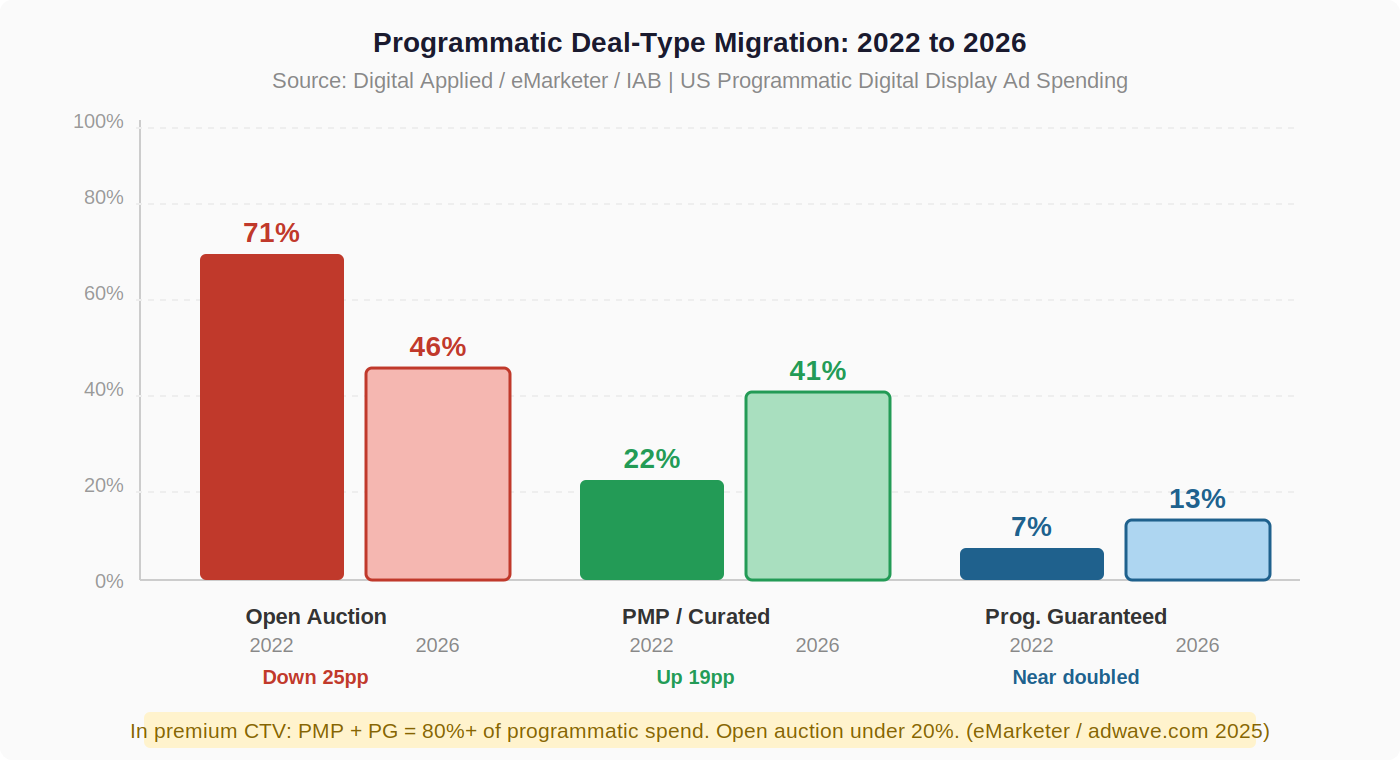
While the industry spent twenty years building real-time auction infrastructure to displace the guaranteed deal, the guaranteed deal kept the budget. Premium Programmatic budgets grew 52 percent year-on-year in Q1 2024 among large US advertisers, nearly three times faster than open exchange. According to eMarketer, 76.2 percent of US programmatic digital display ad spending is expected to flow through programmatic direct channels by 2026. The pipes changed. The deal structure did not.
To understand why, look at the money. Really look at it.
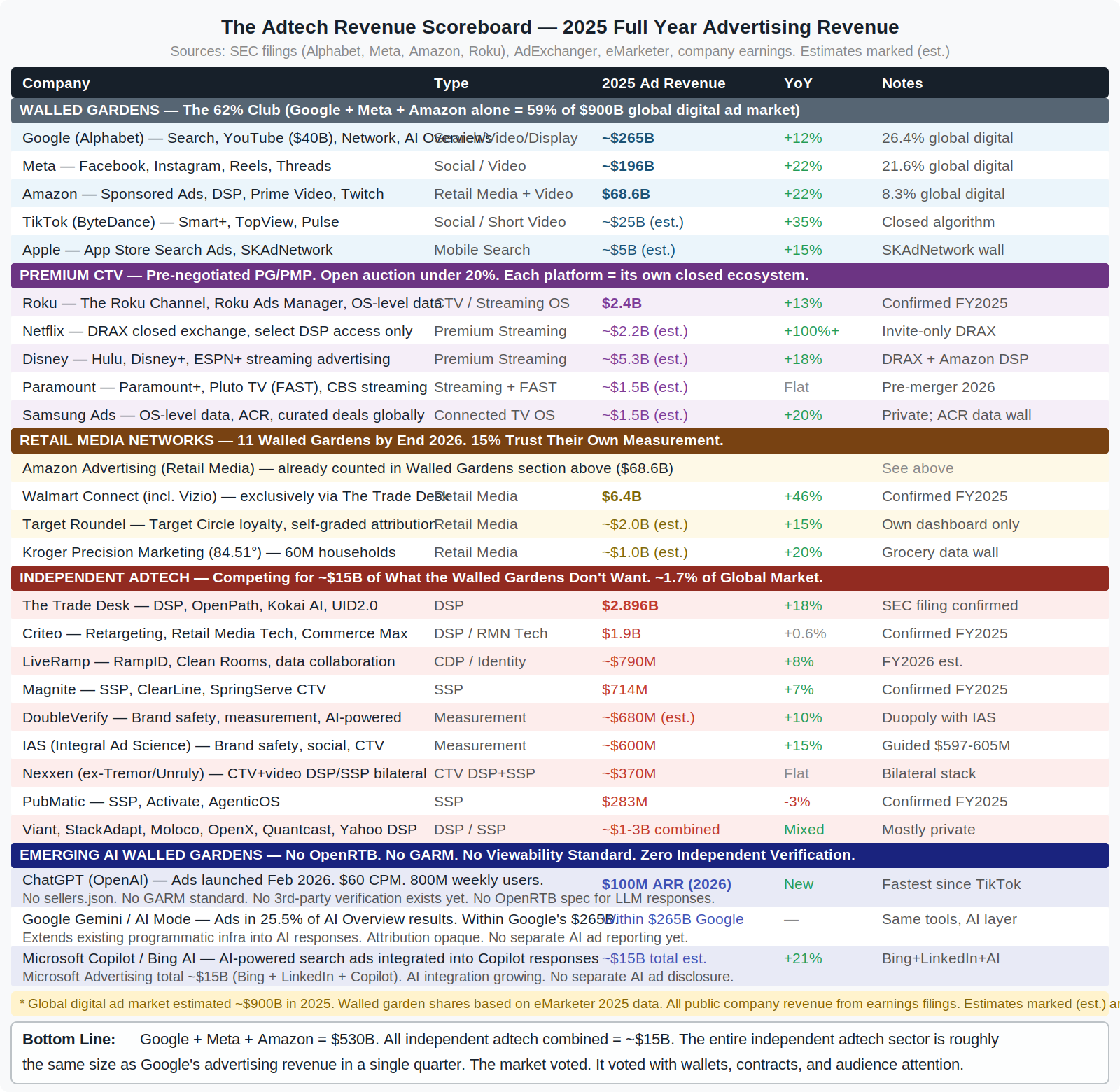
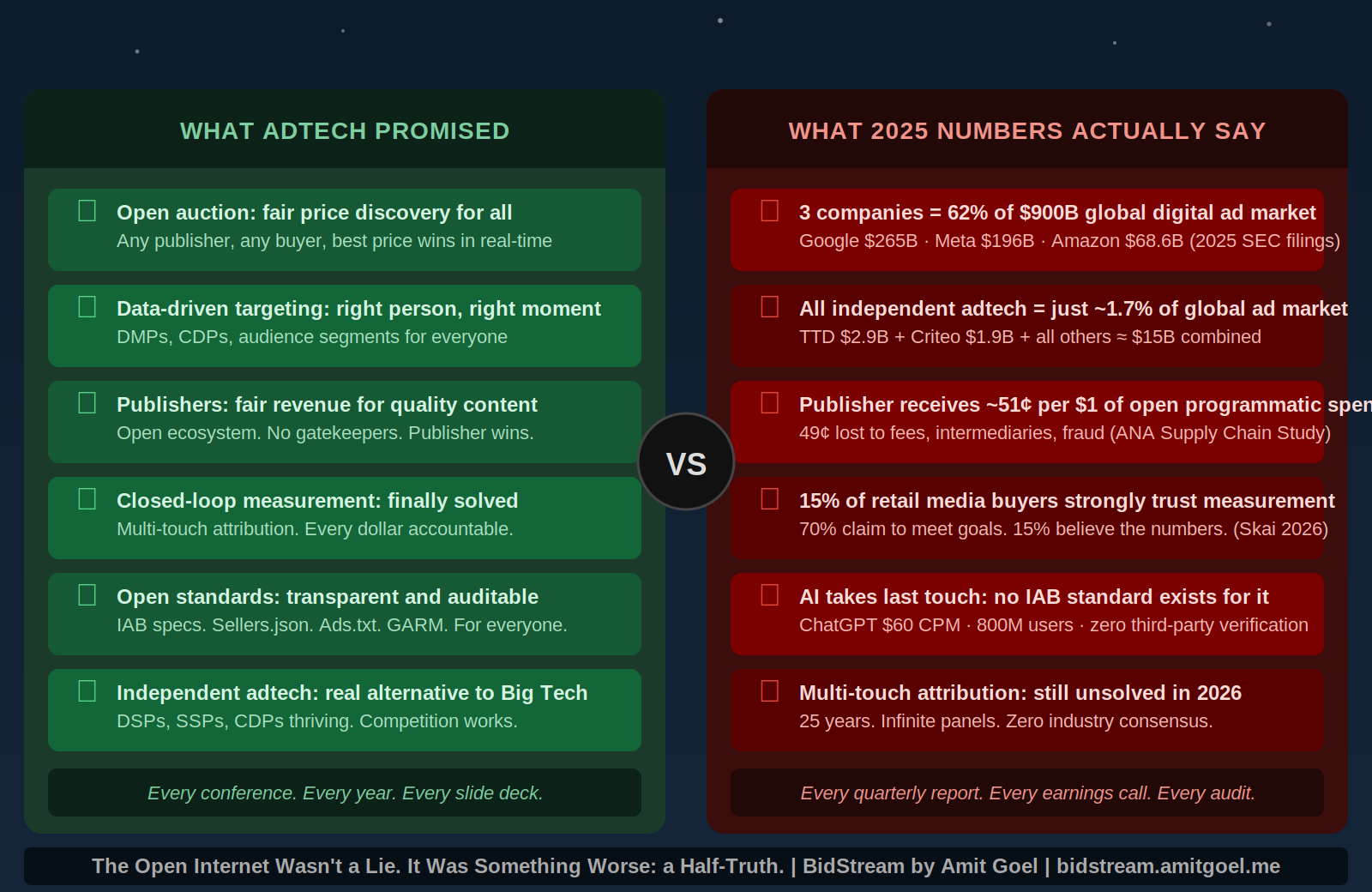
In 2025, Google, Meta, and Amazon collectively generated approximately $530 billion in advertising revenue against a global digital advertising market of roughly $900 billion. That is 59 percent to three companies. Add TikTok’s estimated $25 billion and Apple Search Ads’ estimated $5 billion, and five platforms account for 62 percent of all global digital advertising revenue. The remaining 38 percent is fragmented with every DSP, SSP, exchange, DMP, CDP, clean room vendor, measurement platform, brand safety company, identity graph provider, and independent adtech startup on the planet is fighting over and that includes the walled gardens’ share of fragmentation too.
The specific numbers, because specificity is the enemy of comfortable vagueness: Google’s advertising revenue for FY2025 was approximately $265 billion, verified from quarterly earnings, with Q1 at $66.8 billion, Q3 at $74 billion, and Q4 at $82.3 billion. Meta’s advertising revenue was approximately $196 billion, up 22 percent, per its 10-K filing. Amazon’s Advertising Services came in at $68.6 billion, up 22 percent, per its 8-K. These are SEC filings, not estimates.
On the independent side: The Trade Desk reported FY2025 revenue of $2.896 billion. Magnite: $714 million. PubMatic: $283 million, down 3 percent. Criteo: $1.9 billion, up 0.6 percent. Roku’s advertising revenue for 2025 was $2.4 billion. LiveRamp: approximately $790 million. DoubleVerify: approximately $680 million. IAS: approximately $600 million.
The Trade Desk’s $2.9 billion is genuinely impressive for an independent technology company. It also represents roughly 1.1 percent of what Google reported in the same year. Google doesn’t think of The Trade Desk as a competitor. It thinks of it the way a whale thinks of a barnacle: useful for demonstrating ecosystem diversity, not a strategic threat.
Walmart Connect generated $6.4 billion in global advertising revenue in 2025, growing 46 percent. Netflix’s advertising revenue more than doubled to approximately $2.2 billion; the company now runs its own in-house ad server, the Netflix Ads Suite, built from scratch and launched in 2025 after Netflix spent two years moving away from Microsoft’s Xandr infrastructure. Disney’s streaming advertising across Hulu, Disney+, and ESPN+ reached approximately $5.3 billion. Every one of these is a walled garden. Amazon’s audience data requires Amazon DSP. Walmart routes through The Trade Desk and its own systems. Netflix inventory is accessible programmatically through The Trade Desk, Google’s DV360, and Magnite as SSP, all sitting on Netflix’s own ad server. Disney runs DRAX, the Disney Real-time Ad Exchange, which covers its entire streaming portfolio and integrated with Amazon DSP in June 2025.
The market structure is not a crisis. It is arithmetic, and it explains every other paragraph in this article.
The Rebrand Machine: Reinventing the Same Ideas With Better Names
Adtech has a superpower that has nothing to do with algorithms or machine learning. The ability to take an existing concept, rename it, give it a three-letter acronym, build a conference track around it, and charge enterprise prices for the renamed version. The industry has been running this play since roughly 2010 with remarkable consistency.
The insertion order was invented in 1994. In 2008, the industry automated it and called it programmatic advertising. In 2012, when publishers wanted to protect premium inventory, the negotiated IO became a “Private Marketplace” or “Deal ID.” In 2018, the guaranteed-impression, fixed-CPM, non-auctioned deal was rebranded “Programmatic Guaranteed.” In 2025, these same guaranteed deals are being dressed up with AI labels and called “agentic-powered curated inventory.” The document AT&T and HotWired signed in 1994 has been renamed four times. It still says: I will buy X impressions from you at Y price. The pipe changed. The deal did not. The conference registration fee stayed the same.
“Many platforms are rolling out AI-supported, unified campaign solutions that emphasize price, performance, and convenience, even as they demand tradeoffs in transparency and control.”
Madison and Wall, Q3 2025 AdTech Earnings Review, via Marketing Dive
The data vocabulary follows the same pattern. Third-party cookies became “identity graphs.” Identity graphs became “first-party data activation.” First-party data activation required a “data clean room.” Clean rooms, which are secure database environments with controlled access, have existed in enterprise IT since the early 1990s. Adtech discovered them in 2020 and immediately added platform fees. DMPs became CDPs when cookies started dying. CDPs became “data collaboration platforms” when CDPs weren’t delivering. At each renaming, the conference session was booked, the Digiday article was written, and the vendor deck said “transformative.”
The contextual targeting revival is the most revealing example. Before behavioral tracking at scale existed, advertising was targeted by context: car ads on automotive sites, finance ads on business pages. The industry spent fifteen years building cookie-based behavioral infrastructure and told publishers their editorial context was largely irrelevant to pricing. When cookies started disappearing, contextual targeting was repackaged as “the privacy-first solution” and positioned as an innovation. The industry went backwards, called it forward, and put it in a keynote. Nobody in the room looked embarrassed.
Now consider what “agentic AI” has actually produced for independent adtech so far. PubMatic’s AgenticOS drove 250 agentic deals in full year 2025, per its earnings release. PubMatic processes 78 trillion impressions per quarter. Two hundred and fifty agentic deals is not a product line. It is a press release with a number in it. Magnite partnered with Cognitiv to “enrich the programmatic bidstream with AI,” which in practice meant adding a machine learning layer on top of RTB infrastructure it already operated. The Trade Desk’s Kokai platform redesign arrived late, was adopted slowly, and its Q1 2026 guidance implied just 10 percent year-on-year growth, down from 25 percent the previous year. Nobody mentioned that in the keynote either.
Compare that to what the actual AI platforms built. Meta’s Advantage+, Amazon’s Performance+, and Google’s Performance Max were created from scratch on first-party data at scale. According to Meta, Advantage+ drove a 22 percent improvement in return on ad spend for e-commerce advertisers in 2025 trials. Amazon’s ML bidding system optimizes across hundreds of billions in gross merchandise value with real-time signals that no independent DSP can access. You can’t rebrand your way to these capabilities. You need the audience first, and the audience is inside the walls.
True Programmatic Has Never Actually Happened. Here Is Why That Matters More Than Ever.
“Programmatic” has been doing heavy lifting in advertising vocabulary for fifteen years, and the industry’s dirty secret is that it covers two completely different activities. One is a real-time competitive auction where the highest-value buyer wins an impression the moment it becomes available, based on live audience data, live pricing signals, and live creative decisioning. The other is automated execution of a deal two humans negotiated weeks or months ago. The industry calls both programmatic. One is genuinely revolutionary. The other is an API wrapper on a fax machine.
In premium CTV, PMPs account for about 60 percent of programmatic transactions and programmatic guaranteed deals about 35 percent, per adwave.com’s Q3 2025 analysis. Open auction, where any buyer can bid with no prior negotiation, represents under 20 percent of all programmatic CTV, concentrated in FAST channels like Tubi and Pluto TV.
In digital out-of-home, private deals account for 95 percent of spend on the Place Exchange platform.
In audio, Spotify’s premium inventory trades through direct and PMP. The programmatic pipes are live and functioning. What they are mostly transporting is guaranteed deals.
“Many of these formats require custom creative work across different platforms to get scale. We’re getting there, but it’s still a hurdle.”
Matt Van Houten, SVP Product & Partnerships, DirecTV Advertising, 2025
Why PG Exists and Why It Is So Stubborn
PG persists for one reason technology can’t fix: both parties prefer the certainty. A broadcaster selling premium CTV inventory upfront knows approximately how many people will watch a series based on historical viewing data. An advertiser buying that inventory knows approximately what reach they are getting. Both sides accept demographic estimates rather than individual guarantees in exchange for knowing the price and the committed volume in advance.
A publisher who switches from PG to real-time pricing takes on real risk: no committed revenue floor, no guaranteed fill rate, and the volatility of a market that prices based on who is actually watching rather than who was projected to watch. An advertiser who switches from PG gets more precise audience targeting but loses the ability to plan creative resources against a known delivery schedule. PG isn’t a technology failure. It is rational risk management by both parties in a market where uncertainty is expensive.
The CTV ad format gap shows how deep this problem runs. In December 2025, IAB Tech Lab released standardized specifications for six CTV ad formats for public comment: pause ads, menu ads, squeezeback formats, overlays, in-scene insertions, screensaver ads. The comment period closed January 31, 2026. The squeezeback, which compresses content to display an ad alongside it, has been a standard part of British linear television since the early 2000s. Sky Sports was running animated bugs and credit squeezes during Premier League coverage before smartphones existed. The L-band format appeared on BSkyB before most people working in CTV advertising today had graduated secondary school. An industry still defining what a pause ad looks like in December 2025 is not ready to replace the upfront with live audience auctions. You need the product before you can build the market.
Fubo TV claimed a “first” in 2025 when it offered programmatic buying of pause ads via Magnite’s ClearLine: one publisher, one format, one platform. Had the industry genuinely been innovating CTV infrastructure for a decade, this would have happened in 2019.
Agentic AI Can’t Reach Its Potential in a PG/PMP World
This is where the industry’s AI narrative runs into its most uncomfortable wall, and the wall is made of spreadsheets from Q4 2025 media plans.
Agentic AI in media buying is designed to do three things at scale that humans do poorly: real-time audience evaluation, dynamic bid optimization, and rapid creative personalization. When an AI agent evaluates an impression opportunity, it should be asking, in about 200 milliseconds, who is this viewer, what context are they in, what should I pay for this moment, and which creative version will perform best? That is what real programmatic at individual impression level looks like. And that is precisely what can’t happen inside a PG deal.
When 80 percent of premium CTV inventory is locked in a PG deal negotiated six months before the campaign runs, the AI agent is not making a 200-millisecond decision. It is executing a six-month-old decision made by a human media planner in a quarterly planning cycle. The CPM is fixed. The placement is fixed. The audience commitment is fixed. The creative rotation may have some flexibility, but everything that makes AI genuinely valuable, real-time decisioning, live audience optimization, dynamic pricing, has been removed from the equation before the campaign brief was written.
PG deals commit to specific impressions at a specific CPM regardless of who is actually watching at delivery time. The audience guarantee is demographic, Women 25-54 with household income over $75,000, not individual. The AI agent knows the composition of that demographic better than any human planner. It still cannot change the price, change the placement, or walk away from the deal. The parameters were set in February. The agent is managing delivery in November. This is not intelligence. It is a very expensive reminder system.
PubMatic’s 250 agentic deals points in the right direction, getting AI agents to negotiate and execute deals rather than humans, but negotiating a PG deal with AI isn’t fundamentally different from negotiating it with a junior planner using better software. The agent needs real-time inventory to make real-time decisions. In a market that is 80 percent pre-committed, the agent optimises the margins around a plan rather than building the plan from live signals.
The industry is building AI agents for the programmatic market that currently exists: mostly PG and PMP, mostly pre-negotiated, mostly operating at campaign level rather than impression level. What AI agents actually need to reach their potential is the programmatic market that doesn’t yet exist at scale: real-time priced, authenticated individual-level impressions, where the agent can optimise against current audience data, current campaign performance, and current creative signals simultaneously, in 200 milliseconds, across every impression the brand buys. Until that market exists, “agentic AI” in adtech is mostly a planning productivity tool wearing a very exciting name badge.
How CTV Moves From Upfronts to Real-Time Decisioning
Upfronts don’t disappear because the industry decides they should. They disappear when the conditions that created them, anonymous mass audiences, imprecise measurement, and the need for revenue certainty, are replaced by something better. Two of those three conditions are already changing in streaming, and the third is starting to.
Every viewer of Netflix is logged in. Every viewer of Disney+ is logged in. Every Amazon Prime Video viewer has an Amazon account with purchase history. Every Roku user is registered. For the first time in television’s history, the identity of every streaming viewer is known before the ad runs, not probabilistically, not via panel data, but deterministically, because authentication is a condition of access to the platform. That is the condition that makes the upfront eventually negotiable.
Disney understood what this means. In April 2025, the company expanded biddable ad technology across its streaming platforms, making live content from Hulu and Disney+ available through programmatic biddable integrations. Not a PG deal. A real-time bid on a verified individual at a specific content moment. An advertiser can tell the system: I want to reach 35-49-year-old male car intenders who haven’t seen my creative in the last 14 days, at this content moment, at this price. The system executes with no upfront commitment required.
SCTE 35 signals fire at every ad break in streaming broadcasts. Dynamic Ad Insertion is already live on Amazon’s Thursday Night Football, YouTube’s NFL Sunday Ticket, and Disney’s ESPN+. A DSP can, in principle, receive those signals, evaluate the authenticated viewer’s profile, bid accordingly, and deliver the correct creative within the latency window of a streaming ad break. For server-side DAI, that window is 200-500 milliseconds. Technically achievable today, at scale, on authenticated streaming audiences.
Upfronts survive as a risk management product for advertisers who need revenue certainty and reach guarantees. Real-time biddable grows as a performance product for advertisers who need audience precision. Premium inventory doesn’t defect from one model to the other overnight; what changes is the share. Industry analysts project addressable CTV to reach $28 billion in the US by 2030, growing at 32 percent annually, per eMarketer. Some portion of that will be real-time, authenticated, impression-level decisioning. Not the end of the upfront. The beginning of the market the upfront can’t serve.
Live Sports: The Last Guaranteed-Deal Fortress, and the Path Through
Live sports is the most expensive, most watched, and most resistant category in advertising. The NFL, the Premier League, the NBA, the Olympics, these are not just programming. They are the last mass-audience live events in an era of fragmented, on-demand attention. A concurrent audience of 100 million people watching the same moment is extraordinarily rare, and advertisers pay for that scarcity. The Super Bowl 30-second spot costs approximately $7 million. That price reflects the value of the shared cultural moment, not the precision of the targeting. An open auction wouldn’t clear above it, because the value is in the moment itself, not the individual profile.
But within those 100 million Super Bowl viewers, there are meaningful segments worth targeting precisely: fifteen million male auto-intenders aged 35-55, eight million people actively in-market for insurance, four million households with children under 12. A truly programmatic sports model wouldn’t replace the mass-reach buy. It would add an authenticated addressable tier alongside it, for advertisers who need precision more than reach.
The technical infrastructure for this is already in place for streaming. SCTE 35 signals fire at every ad break in streaming sports broadcasts. DAI is already live on Amazon’s Thursday Night Football, YouTube’s NFL Sunday Ticket, and Disney’s ESPN+. In principle, these platforms can replace a national broadcast spot with an individually targeted ad in the streaming version, differentiated by the viewer’s authenticated identity. In practice, three things prevent this from working at scale today.
Rights holders won’t move to real-time pricing as long as upfront commitments pay more reliably. The NFL earns approximately $10 billion per year from broadcast partners who committed upfront and guaranteed. Trading that certainty for the possibility of higher CPMs from addressable targeting requires data that makes an airtight case. The data exists on authenticated streaming platforms. It hasn’t yet been compiled and shared in a way that closes the argument. Creative is a second problem: sports advertisers produce hero TV spots, not personalized variants, and serving different ads to different viewers in the same game break requires multiple creative versions and trafficking infrastructure that most advertiser operations aren’t built to handle. And measurement feedback is too slow for agents to optimize live bids. The viewer sees the car ad during halftime, researches the model three days later, visits a dealer two weeks after that. An agent can’t make live bid adjustments without near-real-time outcome signals, and that signal chain across authenticated view, purchase intent, and conversion is a multi-year infrastructure project.
Addressable sports advertising develops first in streaming-only events where every viewer is authenticated, second for performance-oriented advertisers like DTC brands and insurance companies who have faster outcome signals and clearer ROI models, and third during lower-stakes games where publishers are willing to experiment with pricing. The Super Bowl upfront isn’t going anywhere in the next decade. By 2030, a meaningful share of streaming sports inventory, perhaps 20 to 30 percent, will trade in real-time based on authenticated audience data rather than upfront demographic projections.
For agentic AI, live sports is actually the most promising near-term use case, not for buying the impression in real-time, but for negotiating the deal intelligently. An AI agent that can evaluate a rights holder’s sports inventory package, compare it against audience delivery alternatives, model expected outcomes across multiple creative versions and audience segments, and propose an optimal deal structure in seconds rather than weeks is a genuine productivity leap. The real-time auction for the live Super Bowl impression is a five-to-ten-year problem. Intelligent deal negotiation for the streaming sports upfront is a two-to-three-year problem. Sequence the ambitions accordingly.
Measurement: Last Touch Is the Industry’s Operating Reality. Build Around It, Not Against It.
Last-touch attribution is not a fiction. Anyone who calls it one has a consultant to sell you. Last-touch is the industry’s operating reality: it has been since the first ad server, it is now, and it will be for the foreseeable future. One problem: it’s the only measurement metric the entire industry agrees on, nobody independent is verifying it, and the platforms that benefit most from it are the same platforms that control the last step before purchase. Google paid search, Meta retargeting, Amazon Sponsored Products. Calling that a coincidence requires more optimism than the data supports.
“Digital media continues to grow exponentially, and with it, a dark side persists, and in some cases, has gotten worse. We don’t want to waste time and money on a crappy media supply chain.”
Marc Pritchard, Chief Brand Officer, Procter & Gamble, IAB Annual Leadership Meeting
Last-touch works as an operational tool. If someone clicks a Google ad and buys, that click happened, and measuring it is legitimate. The trouble starts when last-touch becomes the only model, because it eliminates all accountability for the awareness, consideration, and intent-building that happened before the final click. The CTV campaign that ran three weeks before the search. The editorial that shaped the decision. The social post that introduced the brand. None of those get credit. All the credit goes to whoever was standing at the door when the customer arrived, regardless of who built the road. Google, Meta, and Amazon built the last mile. The rest of the industry built the road. Last-touch pays only for the last mile.
With AI, this goes from bad to worse. When a customer asks ChatGPT for a product recommendation and ChatGPT names a brand, last-touch attribution gives OpenAI 100 percent of the credit. The brand that spent months on CTV, social, and display building awareness gets zero. The publisher whose editorial coverage informed ChatGPT’s model knowledge of that brand gets nothing either. And OpenAI has no attribution model at all; it launched its ad product in February 2026 and has no independent measurement infrastructure in place. The industry is walking into the AI advertising era with a measurement framework that was already broken and is about to break in entirely new ways.
Accept last-touch as the baseline. Then mandate independent verification of it, at the same level the industry mandated viewability verification in 2014. When the MRC established viewability standards, it didn’t ask Google and Meta to self-report. It created an independent audit standard that third-party measurement companies implemented. Attribution needs the same treatment: not as an optional add-on that gets cut in the first budget negotiation, but as a baseline campaign condition. An advertiser buying on ChatGPT at $60 CPM should require an independent partner to verify delivery and measure downstream outcomes, the same way it requires DoubleVerify to verify viewability on YouTube. The tool exists. The mandate does not.
Measurement fails the same way across programmatic, CTV, retail media, and AI. The people who would have to fix it benefit from it remaining unfixed. The publisher runs the ad server and reports impressions. The retailer runs the attribution and reports ROAS. The platform optimizes its own algorithm and reports performance improvements. The ANA documented that publishers receive roughly 51 cents of every dollar spent in open programmatic display. The other 49 cents goes to fees, intermediaries, and technology layers insulated from measurement because transparent measurement would reveal what they cost.
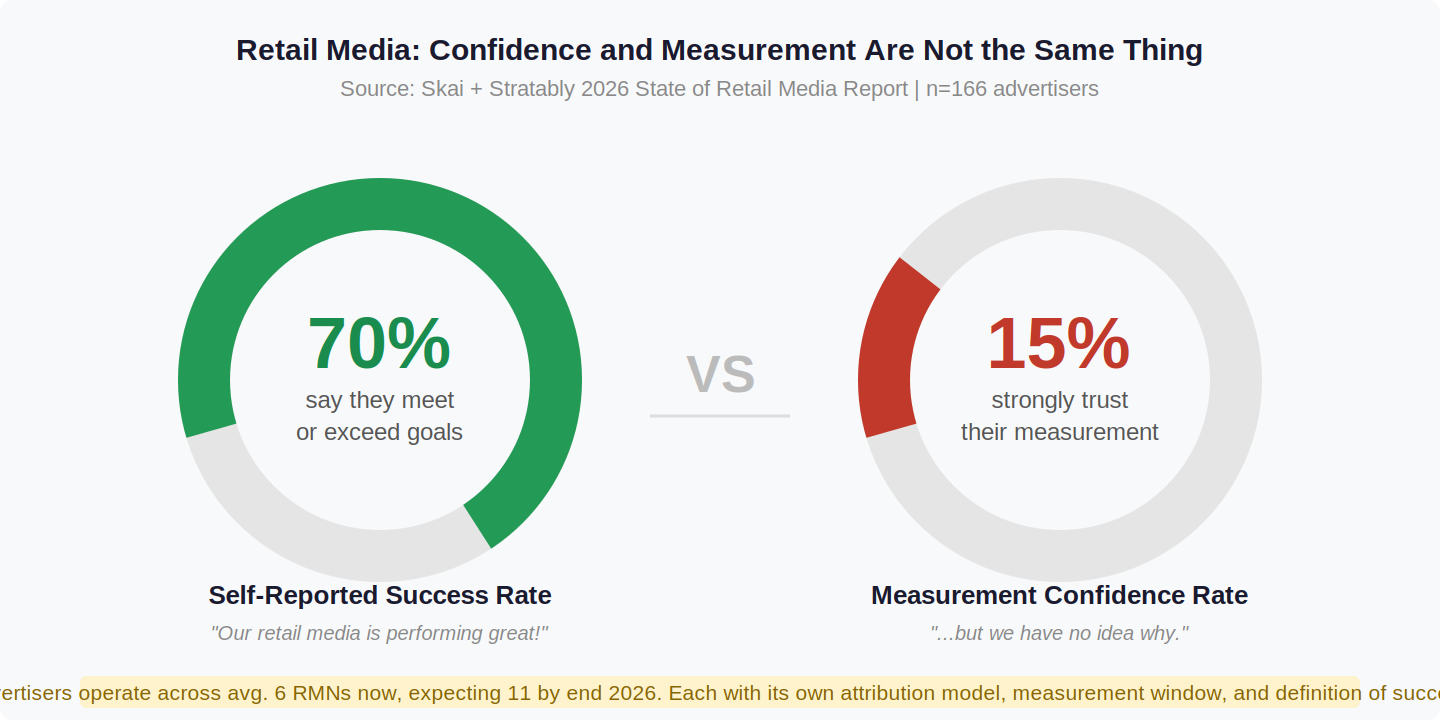
Retail media was supposed to be the exception, the closed-loop attribution the industry had been promising since the first ad server launched. Skai and Stratably’s 2026 State of Retail Media survey found 70 percent of brands claim to meet or exceed their retail media goals. Fifteen percent strongly trust their measurement. Advertisers are operating across an average of six retail media networks, each with its own attribution window, each with its own definition of incrementality. As Profitero’s Chief Growth Officer Mike Black put it: “As an industry, we throw the word Incrementality around a lot, but do any of us EVEN AGREE on what it means?” No. Eleven dashboards by end of 2026. Eleven definitions. Zero consensus.
AppsFlyer and Adjust in mobile, DoubleVerify and IAS in display and video, have built genuine businesses as measurement partners. Access is their Achilles heel. Their access depends entirely on platforms granting permission. Meta selectively expanded third-party measurement access in 2025. IAS called this a milestone. It was a milestone in Meta’s permission granting, not in independent accountability. When a verification vendor celebrates receiving access, it is not acting as an auditor. It is acting as a guest who is grateful to be let in. Guests don’t set the terms. Major buyers, holding companies, major CMOs, and the ANA need to make independent measurement a non-negotiable condition of spend. You don’t negotiate brand safety with Google by asking Google to self-report. You require an independent layer. Attribution should be no different.
New Walled Gardens: Interoperable Walls Are Still Walls
In April 2025, a federal judge ruled that Google had willfully monopolized the publisher ad server and ad exchange markets. The industry celebrated. The remedy is still pending. AdX is still running. Google’s ad business is structurally intact. While the lawsuit was being litigated, new walled garden infrastructure was being assembled by companies the antitrust case didn’t name.
Netflix launched its ad-supported tier in November 2022 with Microsoft’s Xandr as its primary technology partner. By May 2024, Netflix had decided to build its own stack. At its 2024 upfront, Netflix president of advertising Amy Reinhard announced the company was building the Netflix Ads Suite, its proprietary in-house ad server, and adding The Trade Desk, Google’s DV360, and Magnite as programmatic partners. The Netflix Ads Suite was live by 2025. Microsoft, for its part, shut down Xandr Invest, its demand-side platform, by February 2026, the quiet ending to a $1 billion acquisition it had made from AT&T in 2022. Xandr’s SSP and curation layer continue to operate, but the DSP is gone. Netflix inventory now trades through The Trade Desk, DV360, and Magnite. Control stays with Netflix. The buyers just rent access.
Disney runs DRAX, the Disney Real-time Ad Exchange, covering Hulu, Disney+, ABC, ESPN, and FX inventory. Disney integrated DRAX with Amazon DSP in June 2025. Roku’s advertising revenue reached $2.4 billion in 2025, driven by OS-level data across 100 million active households. Samsung Ads operates a controlled marketplace using ACR data that no independent DSP can access without Samsung’s permission. Paramount+ and Pluto TV are consolidating ahead of a likely merger with Warner Bros. Discovery later in 2026. Every premium CTV platform is converging on the same model: control the supply, control the data, control the measurement, and accept buyers’ money on your terms.
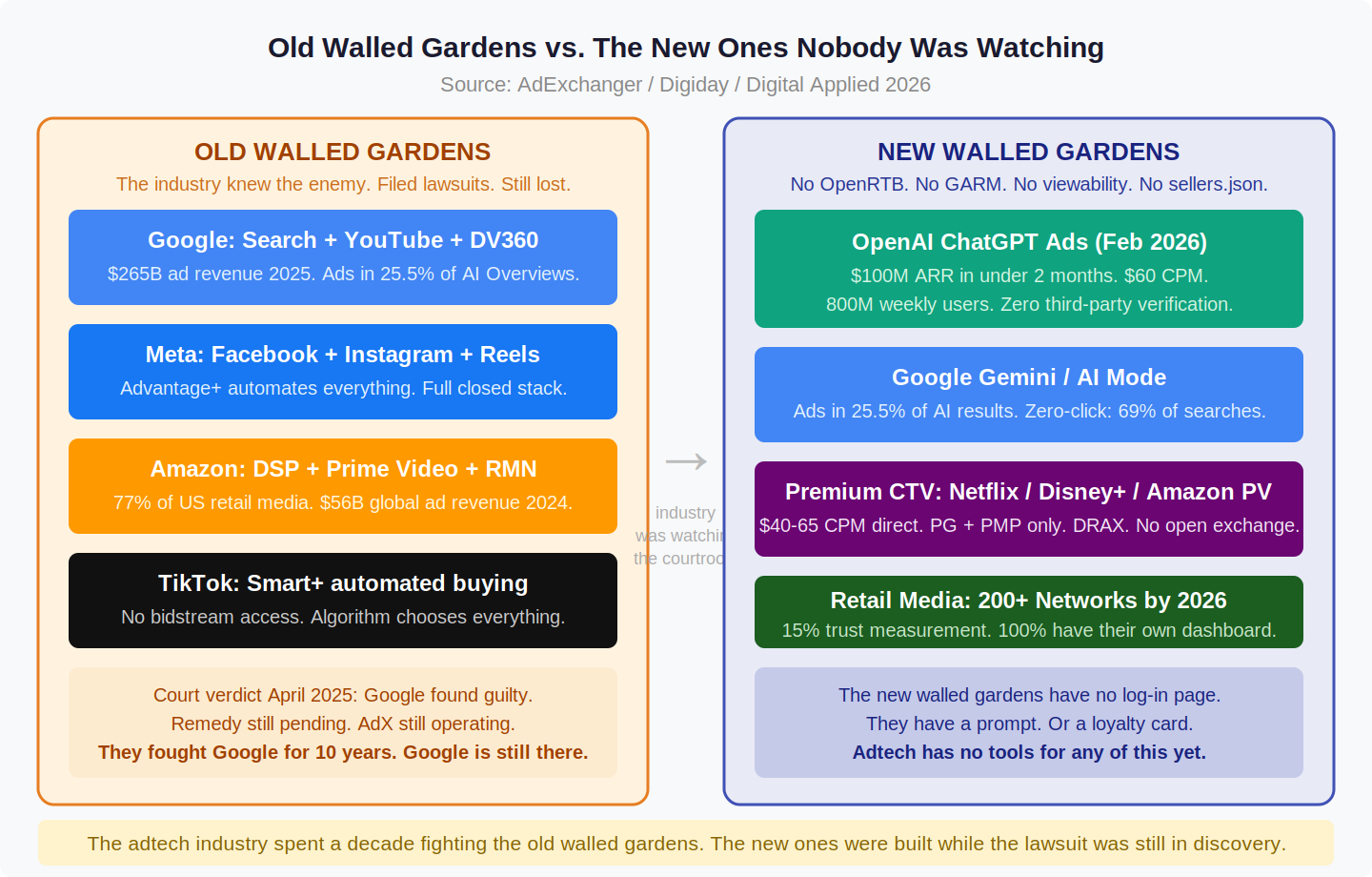
What separates the new CTV and retail media walled gardens from Google and Meta is that they can’t source demand exclusively. They need DSPs and agencies to bring budgets. The industry can call them “interoperable walled gardens,” meaning they control the supply, data, and measurement while cooperating with the demand ecosystem rather than owning it outright. A wall that accepts visitors on a guest pass is still a wall. Visitors don’t set the terms. Visitors don’t audit the data. And visitors get shown the door when the host decides the relationship no longer serves their interests.
Then the AI walled gardens launched, making everything else look almost transparent by comparison. ChatGPT started showing ads in February 2026 at $60 CPM with 800 million weekly active users, the fastest-growing new ad platform since TikTok. Google Gemini is extending existing programmatic infrastructure into AI-generated responses, with ads appearing in 25.5 percent of AI Overviews. Microsoft Copilot is integrating advertising into AI-assisted Office 365 workflows. None of these have an OpenRTB specification. None have a GARM brand safety framework. The transparency architecture of adtech, ads.txt, sellers.json, OpenRTB, the supply chain object, was built for web pages. Conversational AI interfaces are not web pages.
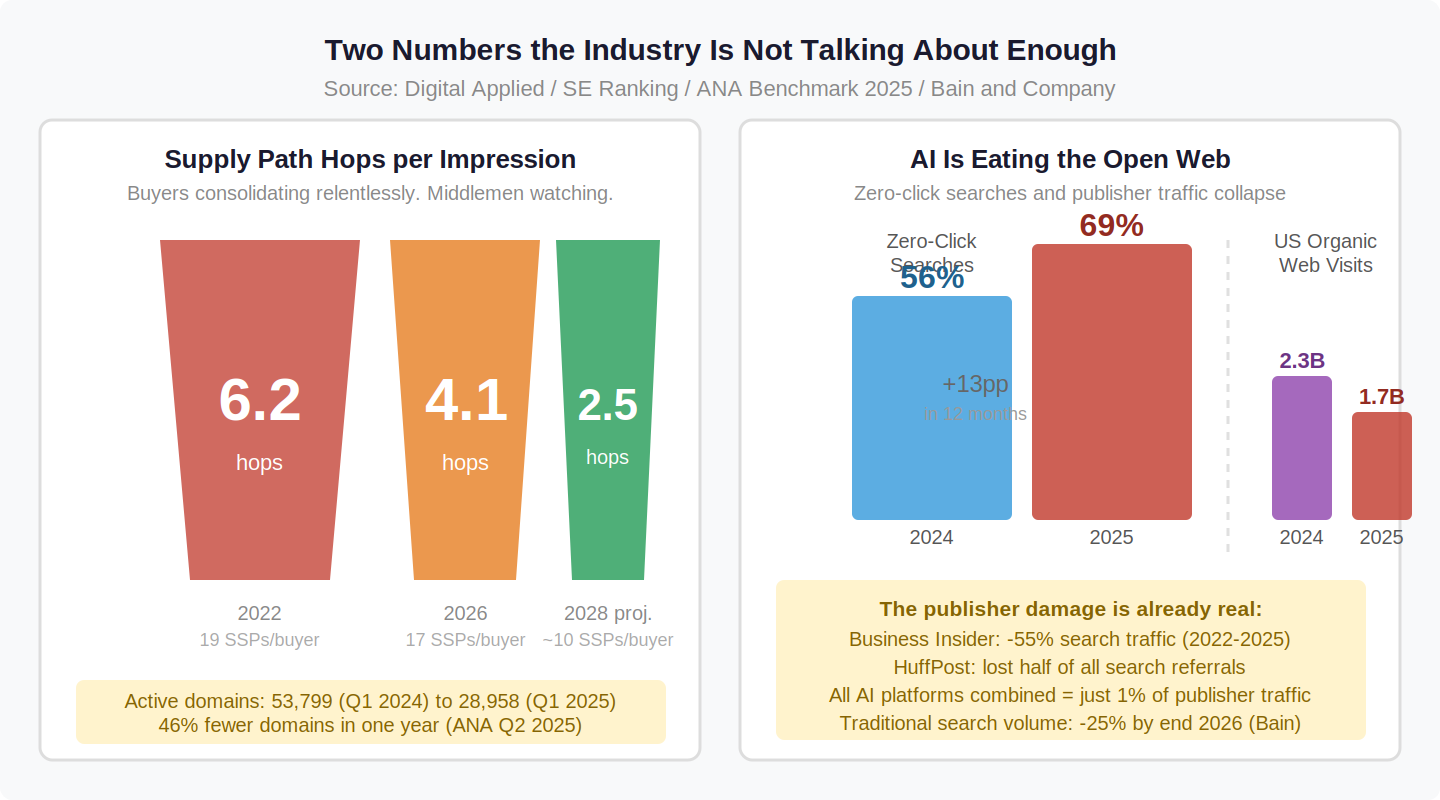
Zero-click searches rose from 56 to 69 percent between 2024 and 2025. Organic traffic to US websites fell from 2.3 billion to under 1.7 billion visits in the same period. Business Insider lost 55 percent of its organic search traffic between 2022 and 2025. All AI platforms combined account for 1 percent of publisher referral traffic. AI is consuming content at scale and answering user questions directly without sending anyone to the source. Traditional search volume is forecast to fall 25 percent by end of 2026. The content that trained these models was created by publishers who aren’t being compensated for training the systems now reducing their traffic. No antitrust case covers this yet.
Credit Where It’s Due, Skepticism Where It’s Warranted
The industry does have people actually building things. They deserve acknowledgement alongside the honest observation that most of the work is harder than the press releases imply and earlier-stage than the conference keynotes suggest.
Index Exchange: the cloud tax is real and they are attacking it. At the IAB Annual Leadership Meeting in February 2026, CEO Andrew Casale outlined containerised models running directly on exchange infrastructure, eliminating the compute cost per bid request that SSPs pass to publishers while accelerating processing from milliseconds to microseconds. Rethinking the physics of an auction rather than renaming it. Worth watching. Skeptic’s note: it is still an SSP competing on efficiency in a market where buyers are cutting the number of SSPs they work with. Efficiency helps. It doesn’t reverse the trend.
UID2.0 is honest infrastructure. Adopted by Index Exchange, Magnite, PubMatic, and Nielsen, live at 400-plus publishers, UID2.0 is deterministic, consent-based, and auditable. The average authenticated match rate of 47 percent is below the cookie era’s 68 percent, but the data is honest. Skeptic’s note: 47 percent match rate means 53 percent of impressions still carry no durable identity signal. The identity problem is smaller than it was. It isn’t solved.
Prebid.org is the most under-appreciated infrastructure in adtech. Open-source header bidding software that runs programmatic auctions for thousands of publishers without taking a percentage of revenue. Infrastructure built as a public good, without a sales team, used by every major publisher in the world. When The Trade Desk and Prebid had their Transaction ID dispute in 2025, over a data field intended to reduce auction duplication and fraud, it was a disagreement between the largest independent DSP and the rails that actually enable open internet buying.
Amazon Marketing Cloud got democratized. AMC became free for all Sponsored Ads advertisers in September 2025, putting a clean room that was previously available only to enterprise managed-service clients within reach of any brand running an Amazon campaign. Amazon remains a walled garden. It is becoming a more honest one, at least on the measurement side. Progress is progress, even when it comes with an Amazon Prime logo.
Moloco is building the right model. Starting in mobile app advertising where it grew by outperforming walled garden algorithms, now expanding into CTV and retail media, Moloco’s bet is that the ML algorithm is the product and a strong enough model can sit on any supply. The company is private and doesn’t disclose revenue, which makes independent verification of its claims impossible. But the model is directionally correct: bilateral, ML-led, outcome-accountable.
IAB Tech Lab released CTV format specs. Finally. The December 2025 CTV Ad Portfolio specification, with standardized definitions for pause ads, squeezebacks, and overlay formats, creates the foundation for programmatic buying of these units at scale. IAB Tech Lab CEO Anthony Katsur acknowledged the industry should expect “several false starts” in agentic standards work. Implementation takes two to three more years. The specification exists. Linear TV had these formats for thirty years without a specification because direct deals came with format briefs. In a programmatic world, you need the spec first. Now there is one.
“Objectivity is key here. Already we’re seeing buyers recognize that data is more valuable in an AI world, and more and more are discovering that sharing that data with conflicted players is dangerous.”
Jeff Green, CEO, The Trade Desk, March 2026
Stop Building Pipes. Start Proving Outcomes.
The open internet is not a lie. A lie implies intent. The people who built RTB infrastructure in 2008 were solving a real problem. The people who built DMPs in 2012 were solving a real problem. The people who built clean rooms in 2020 were solving a real problem. Each time, the solution worked. Mostly. Then the solution became the product, the product became the business model, and the business model became the thing that had to be protected from measurement that would reveal its cost.
That’s the half-truth. The open internet solved distribution, not accountability. It monetized reach, not outcomes. The inventory people actually want, premium streaming, branded audio, high-intent retail surfaces, AI conversational interfaces, was never sold through open auction. The auction monetized what was left. Magnificently, for a while.
Three platforms generate 59 percent of global digital ad revenue. The entire independent adtech sector generates roughly $12 to $15 billion combined. Google reports more than that in a single quarter. AppLovin built $4.7 billion in revenue in 2025 by owning both sides of the transaction: mobile game inventory and a machine learning DSP, growing 44 percent year-on-year, structurally aligned with advertiser outcomes. The commercial model that works in adtech is the one that proves value to both parties in the same deal. The model running out of road takes a percentage of transactions it didn’t improve and can’t measure.
The industry should stop asking “how do we grow the open internet’s share?” and start asking “how do we build advertising infrastructure that proves it worked for everyone, verified by someone with no stake in the answer?”
Five changes. The industry knows what they are. It hasn’t made them.
Mandate independent measurement as a campaign condition, not a budget line item. Every campaign above a meaningful threshold should require an independent measurement partner the same way viewability verification became standard after the MRC established that standard in 2014. Not optional. Not negotiated away when budgets get tight. A condition. AppsFlyer, Adjust, DoubleVerify, and IAS will only achieve meaningful industry access when buyers make that access non-negotiable. The platforms won’t grant it voluntarily. They never have.
Build AI attribution standards now, not in 2028. ChatGPT launched advertising in February 2026. The IAB and MRC haven’t started a working group on AI attribution standards. Building this infrastructure from specification to independent audit to industry adoption takes five to eight years. By 2028 the platforms will have written their own measurement standards, and the industry will be asking nicely for access to data the platforms control, exactly the position it was in with Facebook’s self-reported video metrics in 2016.
Build bilateral platforms. Stop calling DSP and SSP different things. Amazon is both. The Trade Desk builds supply paths. Magnite enables demand access. The DSP/SSP classification is a billing convention from 2010. The test for 2030 is simple: can you show the publisher independently verified earnings, and the advertiser an independently verified outcome? Yes on both means you are relevant. No on either means you are overhead.
Standardize retail media measurement before advertisers stop caring. Eleven retail media networks by end of 2026. Eleven attribution models. The Retail Media Alliance is attempting cross-network standards. Trade bodies with optional compliance don’t fix this. Independent third parties with enforcement authority do. Advertisers spending across multiple RMNs should be able to compare results in a common framework without buying each retailer’s proprietary clean room at full price.
Fund the auditors like they matter, because they do. ANA’s supply chain research, Jounce Media’s SPO analysis, IAB Tech Lab’s format work, these produce the most honest outputs in adtech. They are consistently underfunded relative to the marketing budgets of the companies they audit. The industry spent 49 cents of every publisher dollar on fees and intermediaries. Two cents of that directed toward independent audit infrastructure would change the accountability of the entire ecosystem. An industry that can’t fund honest accounting of its own supply chain has no standing to complain that walled gardens don’t share their data.
Today is May 11, 2026. Radio City Music Hall is running. Billions in guaranteed deals are being signed in New York. The CTV format specs are in adoption phase, arriving roughly a quarter-century after linear TV standardized the same formats. The AI walled gardens have launched, have no independent measurement, and are growing faster than any advertising platform in history. The retail media dashboards are generating numbers 70 percent of advertisers cheerfully report as successes and 15 percent trust. The publisher receives 51 cents per dollar. The supply chain absorbs the rest, mostly without audit.
Markets adjust when the cost of not adjusting becomes visible. The cost is becoming visible, in declining open exchange CPMs, in shrinking publisher traffic, in independent adtech market caps that peaked years ago, in ad budgets migrating to environments the industry has no tools to measure.
The open internet was never quite a lie. But it was never quite enough.
The industry that builds what comes next won’t need to argue about whether the internet is open.
It will just show the results, verified, for both parties, by someone with no stake in the outcome.
Twenty-five years of conferences. The only metric that ever mattered was the one nobody wanted to measure.
Great piece Amit, just 2 Qs if you have a minute - thanks!
1) You mention ~80% of premium CTV is PG/PMP today. Curious if you have a view on what that mix looks like by 2028? Specifically, do you think the new CTV format specs from IAB Tech Lab (pause ads, squeezebacks etc) accelerate the shift to biddable, or do those formats actually entrench PG further because publishers want to control pricing on novel units?
2) You describe the DSP/SSP distinction as a 'billing convention from 2010' and suggest building bilateral platforms. Are you seeing real traction with SSP-side execution paths (like Magnite ClearLine or Index Exchange's similar initiatives) where buyers bypass the DSP for PG/PMP deals? Or is that still mostly conference talk?
Really enjoyed this. I thought you made several strong points and fair criticisms of the open internet narrative, especially around how much of “programmatic” is still negotiated media buying through software pipes.
One question I had is whether comparing total walled garden ad revenue to open internet ad revenue is really apples to apples. Wouldn’t the more relevant comparison be digital ad spend flowing through platform controlled buying and selling infrastructure versus independent DSPs, SSPs, and exchanges?
Even though the majority of digital ad spend still goes to walled gardens, doesn’t that also suggest the open internet is still very large, likely hundreds of billions of dollars, but highly fragmented, inefficiently allocated, and not always bought programmatically today? If the open internet can clean up its supply chain, reduce frictional costs, make campaigns easier to scale, and objectively measure results, wouldn’t that suggest it could move closer to its fair share of consumer time spent, at around 60%?
Big if, but to me that seems like the key question: how will the ad dollars already going to publishers across the open internet be allocated over time? Will DV360, Amazon DSP, niche channel specific DSPs, or proprietary ad agency DSPs be the best way to buy that inventory, or is there still a meaningful role for independent infrastructure that helps advertisers buy and measure across the fragmented open internet more efficiently?